
 0
0

There are 0 items in your cart: Cart Subtotal: $ 0.00
The Quiet Money in K-12 Flows Through Title I Coordinators -- and Most Vendors Have Never Found Them

 The K12 Marketplace
  1
1
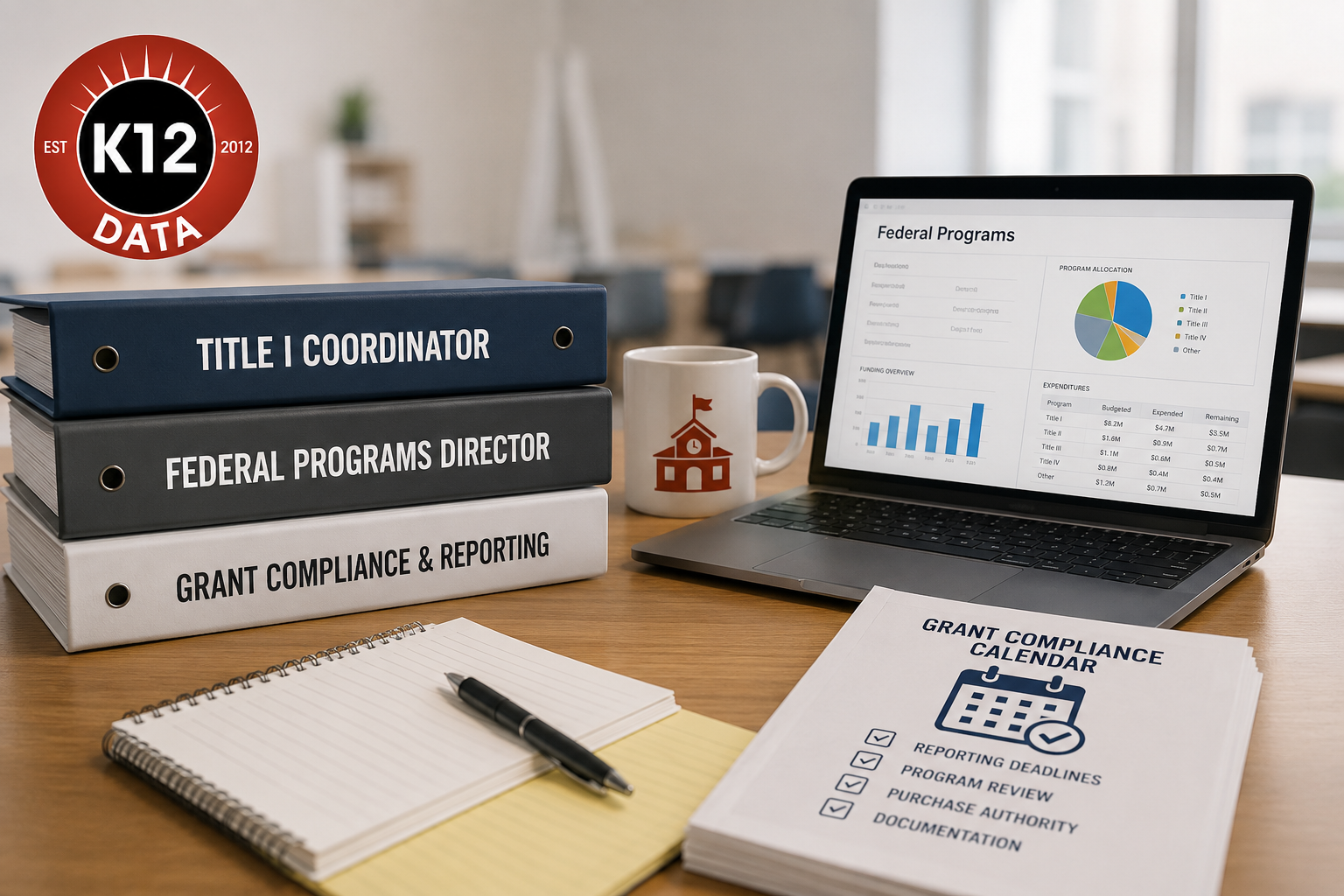
Title I alone channels more than $18 billion annually into schools, administered by Federal Programs Directors and Title I Coordinators who have their own purchasing authority and their own compliance-driven calendar. Most school mailing lists have never included them.
The Quiet Money in K-12 Flows Through Title I Coordinators -- and Most Vendors Have Never Found Them
Every conversation about K-12 vendor strategy eventually circles back to the same contact tiers: superintendents, curriculum directors, technology directors, principals. These are real decision-makers for real purchasing categories, and outreach to them makes sense. But there is a contact tier that controls an enormous and largely separate pool of purchasing authority that almost no school mailing list has ever systematically mapped: Federal Programs Directors and Title I Coordinators.
Title I of the Elementary and Secondary Education Act channels more than $18 billion annually into schools serving low-income student populations. That $18 billion does not sit in the general operating budget, waiting to be allocated through the standard district purchasing process. It flows through a specific administrative channel -- the district's Federal Programs Office -- with its own compliance requirements, its own allowable spending categories, its own reporting timelines, and in most districts, its own administrator who holds direct purchasing authority for the technology and services that support program delivery and federal compliance.
The Federal Programs Director or Title I Coordinator is, in many districts, one of the highest-spending administrators in the building when it comes to educational technology and support services. They are also, with remarkable consistency, missing from the school district email lists most vendors use to reach K-12 decision-makers.
Why This Contact Tier Has Been Systematically Overlooked
The underrepresentation of Federal Programs staff in K-12 contact databases is not an accident. It is a structural artifact of how most school mailing lists were originally built -- around the academic and operational leadership hierarchy that shows up in an org chart: superintendent at the top, curriculum and instruction in the middle, principals and department chairs below. The federal programs function, which in most districts exists in a somewhat separate administrative lane, has been consistently deprioritized in database construction relative to the academic and technology contacts that drive the majority of K-12 vendor outreach.
This is an increasingly expensive omission, for two specific reasons that are both operating simultaneously right now. The ESSER funding cliff, documented extensively in this content series, has not eliminated federal grant money flowing into districts -- it has shifted the primary channel. The pandemic relief funds that created the ESSER wave were exceptional and temporary. Title I, Title II, Title III, and the Individuals with Disabilities Education Act formula funds are permanent, recurring, and in many districts represent the largest and most stable source of discretionary spending available to the administrators managing them. A vendor who built their K-12 pipeline on ESSER relationships and is now wondering where those districts are spending their money needs to look at their Title I Coordinator relationships.
The second reason is the ESSER cliff itself. Many districts adopted educational technology platforms with ESSER funds that are now facing a renewal or replacement decision. The question of whether those platforms qualify for continued funding under Title I's allowable spending categories is, in many districts, the single most consequential factor in whether an incumbent vendor keeps the contract or loses it. A vendor who has never built a relationship with the Federal Programs Director at their key district accounts is operating without a critical piece of intelligence about the future of their own existing contracts.
What Federal Programs Directors and Title I Coordinators Actually Buy
The technology and service categories that Title I funds can support are broader than most vendors assume. Federal allowable-use guidance permits Title I spending on instructional materials and curriculum that serve the low-income student population, professional development and coaching that supports teachers serving Title I-eligible students, assessment and data tools that help schools identify and support struggling students, family and community engagement programs, and in many cases the administrative and compliance technology needed to document, track, and report on Title I program delivery.
That scope creates genuine purchasing authority for vendors in curriculum, professional development, student support, family engagement, and compliance technology -- and that authority sits with the Federal Programs Director rather than with the curriculum director or technology director that most school mailing list outreach targets.
Compliance and Reporting Technology
Federal programs compliance is a year-round administrative function that has grown significantly more complex over the past decade as Every Student Succeeds Act reporting requirements have expanded and as the volume of federal grant programs flowing into districts has increased. Compliance management platforms, grant tracking systems, and the program documentation tools that help districts demonstrate allowable use of federal funds are a purchasing category that the Federal Programs Director evaluates and, in many districts, approves independently of the general technology purchasing process.
Family and Community Engagement Platforms
Title I requires districts to implement meaningful parental involvement programs, and the technology supporting those programs -- multilingual family communication platforms, parent engagement tracking, community resource navigation tools -- is a purchasing category that most curriculum and technology director outreach strategies completely miss because it sits primarily within the purview of the Title I-funded Family Engagement Coordinator or the Federal Programs Director who oversees that function.
Student Support and Intervention Technology
The tutoring platforms, intervention curriculum, and student support case management tools that Title I funds have been used to purchase at scale -- particularly during and after the ESSER era -- represent an active renewal and replacement purchasing cycle right now. A vendor whose student support technology was adopted with ESSER funds needs a Federal Programs Director relationship to understand whether that technology will continue to be funded, and a vendor competing for a new contract needs that same relationship to understand whether their product qualifies for Title I spending.
This purchasing dynamic connects directly to the broader ESSER cliff replacement cycle documented in K12 Data's research on districts as the best B2B target right now, and the compliance calendar overlap between K-12 federal programs and the state agency funding channels documented in Civic Data's research on state agencies that fund schools and colleges. State education agencies administer the Title I formula funding distribution before it reaches districts -- which means the state Title I director at the state department of education is a co-important contact for vendors whose products are funded through this channel.
The Purchasing Calendar That No Standard K-12 Campaign Is Built Around
Federal programs purchasing does not follow the standard K-12 budget calendar. Title I and other ESEA formula funds operate on a federal fiscal year that runs October 1 through September 30, which is offset from the July 1 state fiscal year that governs most district general operating budgets. This offset creates a distinct purchasing window for federal-funds-eligible products that is entirely separate from the standard back-to-school and budget cycle timing that drives most K-12 vendor outreach strategy.
A vendor running a standard back-to-school campaign in July and August is reaching the right districts at the right time for general operating budget purchases. That same campaign is arriving at precisely the wrong moment for Title I purchasing, because federal fiscal year planning is happening in the spring and early summer, and federal fiscal year commitment decisions are happening in September and October. A vendor who has never mapped the federal fiscal year calendar into their outreach strategy is systematically missing one of the most active and recurring purchasing windows in K-12.
How to Build a School Mailing List That Reaches This Tier
• Add Federal Programs Director and Title I Coordinator as distinct, searchable contact categories in your school district email list -- separate from curriculum director and separate from technology director, because they are different roles with different purchasing authority and different calendar alignment.
• Segment by Title I eligibility percentage. Districts where more than 40 percent of students qualify for free and reduced lunch have the largest Title I allocations and the most developed federal programs administrative infrastructure, which correlates with more purchasing authority and more established vendor relationships to potentially displace.
• Build a September and October outreach sequence specifically for federal-funds-eligible products, timed to the federal fiscal year renewal and commitment window rather than to the July-August back-to-school calendar.
• Map the allowable-use category for every product you sell against Title I, Title II, and IDEA eligibility frameworks before outreach begins. A vendor who can tell a Federal Programs Director specifically which federal program category their product qualifies under is demonstrating a level of federal programs literacy that most vendor outreach completely lacks.
Federal programs purchasing connects upward to the state agency layer documented in Civic Data's research on state education funding officials and outward to the higher education workforce and credentialing connections documented in College Data's research on graduate and professional program enrollment growth. The grow-your-own teacher pipeline programs increasingly funded through Title II professional development dollars sit at the intersection of all three -- K-12 district Title II purchasing, community college credential program delivery, and state workforce development funding -- which means a vendor serving this market needs contact coverage across all three sectors simultaneously.
Conclusion
Federal Programs Directors and Title I Coordinators are not a niche subpopulation within K-12. They are, at the thousands of districts where Title I allocations are significant, among the most active and most independent technology purchasers in the building -- operating on their own calendar, under their own compliance requirements, with their own budget that is separate from the general operating fund and insulated from many of the budget pressures that affect general discretionary spending. The vendors who have found them are competing in a purchasing conversation that most of the K-12 vendor market has never entered. The vendors still routing all their school mailing list outreach through superintendents and curriculum directors are reaching real decision-makers for some of their product categories and completely missing the decision-makers for others.
K12 Data -- Build a List | Pricing | Blog College Data -- Build a List | Pricing | Blog Physician Data -- Build a List | Blog Civic Data -- Build a List | Blog K12 Talent -- Post a Job | Search Jobs | Blog