
 0
0

There are 0 items in your cart: Cart Subtotal: $ 0.00
A District Just Lost Universal Free Meals After Four Years, and Families Weren't Ready

 The K12 Marketplace
  0
0
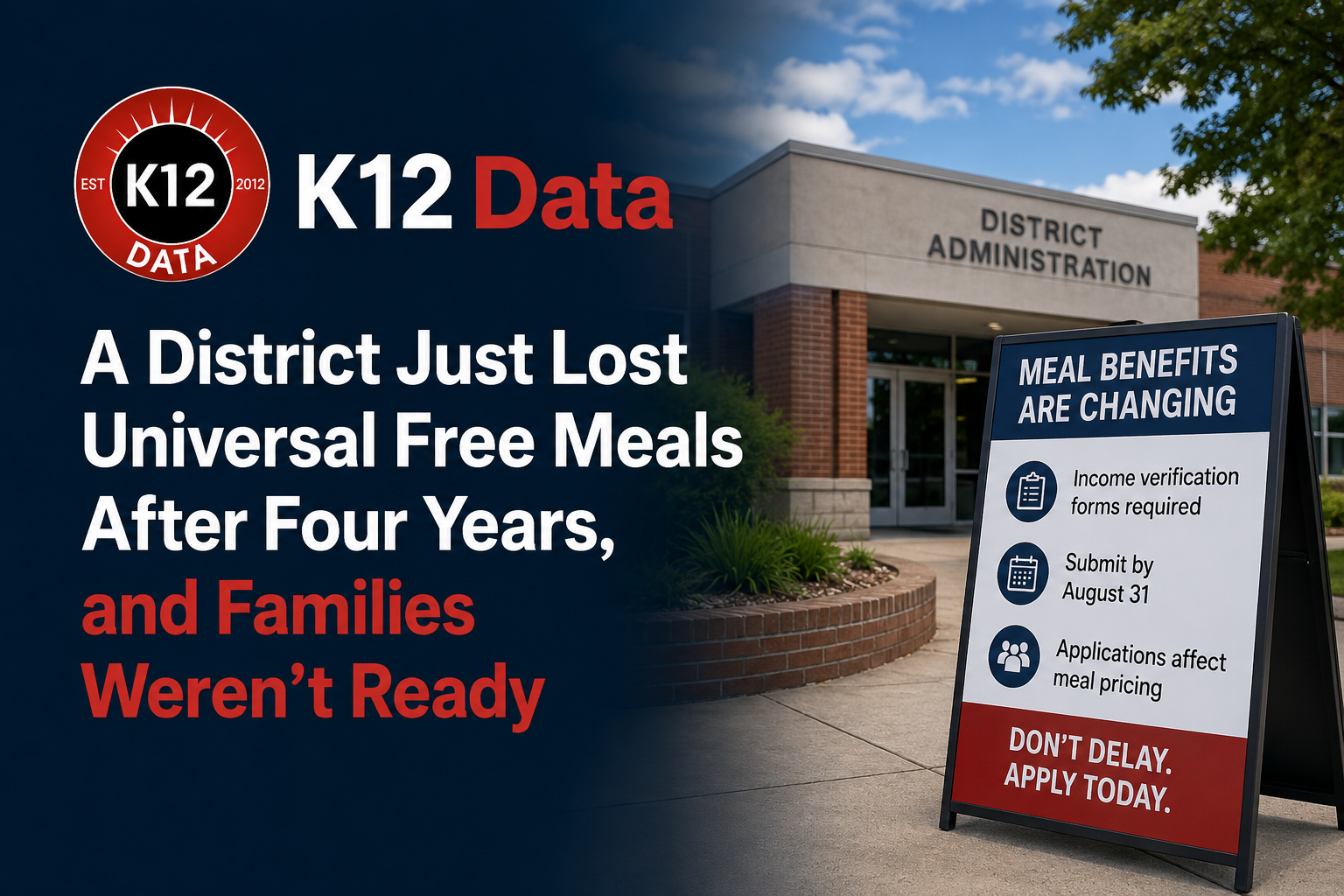
A district lost Community Eligibility Provision status after four years of universal free meals, forcing a sudden return to income verification forms families were not prepared for
A District Just Lost Universal Free Meals After Four Years, and Families Weren't Ready
For four years, families in one district never had to think about school meal costs at all. Every student ate free, regardless of household income, under the Community Eligibility Provision, a federal program that allows high-poverty districts to offer universal free meals without collecting individual household applications. This year, that district no longer qualifies, and the transition back to income-based eligibility has caught families genuinely off guard, revealing exactly how much operational and communications infrastructure districts quietly dismantle once CEP eligibility removes the need for it.
This is a genuinely instructive moment for districts nationwide, since Community Eligibility Provision eligibility is reassessed periodically based on a district's specific poverty metrics, and any district currently operating under CEP faces the same real risk of losing eligibility as circumstances change, often with less advance notice than families or even district staff fully anticipate.
How a District Actually Loses CEP Eligibility
Community Eligibility Provision eligibility depends on a district's Identified Student Percentage, a measure of students automatically qualifying for free meals through participation in other means-tested programs like SNAP or Medicaid, without requiring individual meal applications. When this percentage drops below the required threshold, often due to genuine demographic shifts, changing enrollment patterns, or families moving on or off qualifying assistance programs, a district can lose CEP eligibility even without any deliberate policy change at the district level itself.
This means CEP status is not a permanent designation districts can simply assume will continue indefinitely once achieved. It requires ongoing monitoring of eligibility metrics, and districts operating under CEP for multiple consecutive years can develop genuine organizational blind spots around the operational infrastructure, individual meal applications, income verification processes, direct certification systems, that CEP status made unnecessary and that atrophies from disuse over an extended period of universal eligibility.
What Districts Actually Lose Institutional Memory Around
After four years without individual meal applications, a district's nutrition services and enrollment staff may have genuinely limited institutional memory of how to process income verification at scale, since the specific staff who managed this process before CEP implementation may have moved to other roles, retired, or simply not needed to exercise this specific operational capability in years. This creates a real, practical challenge beyond simply communicating the policy change to families.
"The district offered free school meals for the past four years through the Community Eligibility Provision but no longer qualifies for the federal program."
Districts facing this transition need to essentially rebuild operational capability for individual meal application processing, income verification, and direct certification coordination, capability that may not exist in any current staff member's active working knowledge if enough time has passed since the district last operated without CEP.
Why Family Communication Requires Genuine Care
Families who have never needed to think about meal eligibility, since every student simply ate free for years, are not going to intuitively understand why this is suddenly changing, nor will they necessarily see a communication about it as urgent if it arrives through routine channels easily overlooked amid the general volume of back-to-school communications. Districts navigating this transition need genuinely proactive, multi-channel communication specifically flagging this change as distinct from routine annual back-to-school paperwork, since families may reasonably assume any meal-related form is simply the same non-critical paperwork they have safely ignored for the past several years.
This is particularly consequential for families who may now owe meal costs they did not budget for if they do not complete required paperwork in time, or families who might actually qualify for free or reduced meals under standard eligibility rules but fail to submit an application because they did not realize one was now required after years of automatic universal eligibility.
The Broader Operational Ripple Effects
Meal program eligibility connects to other district functions in ways that are easy to overlook until a CEP transition forces the connection into view. Title I funding calculations in some districts have historically used CEP-adjusted poverty metrics, meaning a loss of CEP status can have downstream effects on funding calculations extending well beyond the cafeteria itself. E-rate technology discount eligibility, in some cases, also connects to meal program participation data, creating another area where a CEP transition can create ripple effects district leadership may not immediately anticipate when first learning of the eligibility change.
Districts navigating this transition benefit from a genuinely cross-functional planning process, bringing together nutrition services, Title I coordination, technology and E-rate administration, and family communications staff to map out the full scope of what actually changes, rather than treating this as a nutrition services problem in isolation from these other connected district functions.
What Districts Currently Operating Under CEP Should Do Now
Districts currently benefiting from CEP status should treat this as a genuine planning prompt, not simply a cautionary tale about a different district's situation. Understanding a district's own Identified Student Percentage trend over recent years, and how close that trend sits to the qualifying threshold, offers real, actionable insight into whether a similar transition might be approaching, giving district leadership genuine lead time to prepare operational capability and family communication strategy well before eligibility actually changes, rather than scrambling reactively once a transition has already been confirmed.
This kind of proactive monitoring costs relatively little in staff time but offers real protection against exactly the kind of family confusion and operational scramble the district in this story is now navigating in real time, discovering gaps in institutional capability and family understanding simultaneously during an already time-pressured transition.
A Concrete Scenario Worth Walking Through
Consider a district that qualified for CEP six years ago during a period of genuine, sustained economic hardship across its community, and has operated with universal free meals ever since without incident. Over the past several years, gradual demographic shifts, some new housing development attracting moderate-income families, some families cycling off SNAP as economic conditions genuinely improved for a meaningful share of the community, have quietly pushed the district's Identified Student Percentage below the qualifying threshold, a change nutrition services staff may not have been actively tracking given how routine universal eligibility had become as simply how meal service worked.
The district learns of the eligibility loss through a standard state notification letter, arriving with a defined timeline for transitioning back to individual applications before the new school year begins. Nutrition services staff, most of whom were hired during the CEP era and have never personally processed individual meal applications at scale, now face both a genuine technical challenge, rebuilding an application processing and verification system essentially from scratch, and a communications challenge, explaining a meaningful change to families who have had no reason to think about meal eligibility in years and may reasonably assume this represents an error or a low-priority form rather than a genuinely required step with real financial consequences if ignored.
Why State-Level Support Varies Considerably
State education agencies vary meaningfully in how much direct support and advance notice they provide districts navigating a CEP eligibility change, and districts should understand their own state's specific process rather than assuming a uniform national experience. Some states provide considerable advance notice and direct technical assistance helping districts rebuild application processing capability. Others provide more minimal notification, leaving districts to independently navigate the transition with comparatively less direct state support.
Districts uncertain about their own state's specific process should proactively reach out to their state child nutrition program office well before any eligibility concern becomes acute, both to understand the state's specific notification timeline and to identify what technical assistance resources, if any, the state makes available to districts navigating this exact transition. This proactive outreach costs little and can meaningfully improve a district's preparedness if and when an eligibility change does eventually occur.
The Direct Certification System Worth Understanding Better
Direct certification, the process through which students automatically qualify for free meals based on participation in other means-tested programs without requiring a separate meal application, remains available and relevant even for districts transitioning away from CEP, and districts should ensure this system is functioning effectively as part of their broader transition planning rather than assuming every family will need to complete a full individual application. Students directly certified through SNAP, Medicaid, or other qualifying program participation can often be identified through existing state data matching systems, reducing the actual number of families who need to complete individual applications manually.
Districts that invest in ensuring their direct certification matching process is working effectively before communicating the broader eligibility change to families can meaningfully reduce the administrative burden both for district staff and for families, since a smaller share of the overall student population will actually need to complete individual paperwork if direct certification is capturing eligible students effectively through existing data systems rather than requiring redundant manual application submission.
A Broader Pattern of Institutions Rebuilding Dormant Capability This Year
This dynamic, an organization needing to rebuild operational capability that atrophied during a period when it was not required, is showing up across sectors this year. Higher education is facing a related structural collision too, since a new four-year visa cap is colliding directly with PhD programs that typically run considerably longer. Healthcare is navigating a related compliance shift too, since MIPS Value Pathways are replacing traditional MIPS reporting, and independent practices are about to feel the transition most acutely.
Government agencies are facing a related legal uncertainty too, since a federal executive order aimed at blocking state AI laws is reshaping who government technology buyers actually need to answer to. And K-12 hiring reflects a related structural pressure too, since accelerating school closures are pushing veteran teachers toward the exit rather than into reassignment.
Losing Community Eligibility Provision status after years of universal free meals is not simply a funding technicality. It requires districts to rebuild operational capability and family understanding that genuinely atrophied during a period when neither was needed, and districts navigating this transition well are treating it as a genuine cross-functional planning challenge rather than a nutrition services problem to be solved in isolation. Districts currently operating under CEP should treat this as a real, actionable prompt to monitor their own eligibility trajectory now, well before any transition actually arrives.
Ready to reach the district leaders navigating this kind of operational transition? Build a verified K-12 database, or buy a school email list, with K12 Data today.