
 0
0

There are 0 items in your cart: Cart Subtotal: $ 0.00
A New Vaccine Executive Order Is Confusing Parents, and School Nurses Are Caught in the Middle

 The K12 Marketplace
  0
0
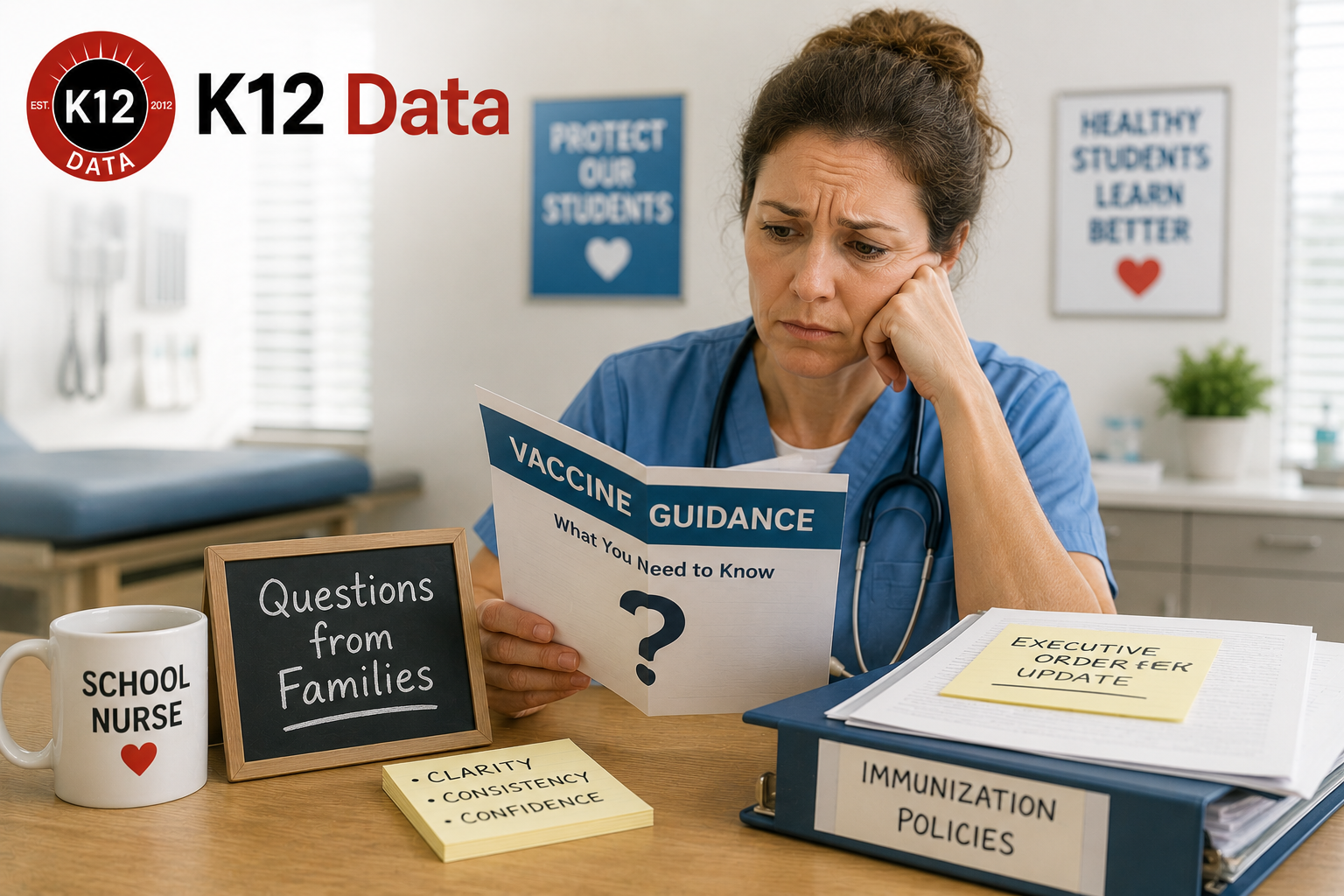
A federal executive order modifying vaccine recommendations, amid rising measles cases, is creating genuine confusion school nurses must navigate directly with families.
A New Vaccine Executive Order Is Confusing Parents, and School Nurses Are Caught in the Middle
Measles cases have climbed past 2,500 nationally this year, and a recent federal executive order modifying vaccine recommendations has arrived at exactly the moment districts can least afford genuine confusion about immunization guidance. School nurses, already managing routine health screenings and chronic condition support for their student populations, are increasingly fielding parent questions about conflicting federal and state vaccine guidance, questions many nurses feel underprepared to answer with full confidence given how quickly the underlying policy landscape has shifted.
For district health services leadership, this is not a distant policy question. It is an active, current communication and compliance challenge landing on school nurses' desks right now, often without the kind of clear, unified guidance that would let them answer parent questions with genuine confidence.
Why This Executive Order Is Creating Genuine Confusion
Vaccine recommendations have historically flowed through a relatively stable, well-understood pathway, federal public health guidance informing state requirements, which districts then translate into clear enrollment and attendance policy. A federal executive order modifying vaccine recommendations disrupts this pathway in ways that are not immediately clear to families or, in some cases, to school nurses themselves, since state-level requirements do not necessarily change in lockstep with federal guidance shifts, creating a genuine gap between what families may have heard about changing federal recommendations and what their specific state and district actually require for enrollment.
This gap is particularly consequential given the timing, arriving as measles cases continue climbing nationally, a disease where high vaccination coverage matters enormously for preventing genuine outbreak risk within school populations. Families confused about whether federal guidance changes affect their own vaccination obligations may delay or skip vaccinations they still genuinely need to meet their district's actual requirements, based on a misunderstanding of how federal and state guidance actually relate to each other in practice.
Why School Nurses Are Uniquely Positioned in This Confusion
School nurses sit at the direct intersection of public health policy and individual family communication in a way few other district staff do, making them the frontline point of contact for exactly the questions this policy confusion is generating. Parents confused about vaccine requirements are calling school nurses directly, often expecting clear, authoritative answers about a policy landscape that genuinely lacks the clarity to provide those answers confidently right now.
"A recent executive order modifying federal vaccine recommendations may sow confusion for parents and add administrative burdens for school nurses amid rising nationwide measles cases."
This creates real, direct pressure on school nurses to develop genuine fluency in a rapidly shifting policy area that extends well beyond their traditional clinical training, requiring them to essentially become a district's de facto vaccine policy communication resource without necessarily having been given the specific training or clear institutional guidance this role increasingly requires.
The Administrative Burden This Creates
Beyond the direct family communication challenge, school nurses are facing genuine administrative burden translating shifting federal guidance into concrete, actionable district policy and documentation. This includes updating enrollment paperwork and health screening protocols to reflect current requirements accurately, tracking which specific vaccines remain required under state law regardless of federal guidance changes, and maintaining clear records that protect both families and the district as this policy landscape continues evolving.
Districts without dedicated health services leadership beyond individual school nurses face a particularly acute version of this burden, since a single nurse managing this policy translation work for an entire district, on top of routine daily health services responsibilities, has genuinely limited capacity to develop and maintain current, comprehensive guidance without additional district-level support specifically dedicated to this compliance and communication function.
Why Clear Family Communication Matters More Than Ever
Districts navigating this moment well are recognizing that ambiguous or delayed communication about vaccine requirements carries real public health stakes given the current measles case trajectory, not simply an administrative inconvenience families can work through on their own timeline. Clear, proactive communication distinguishing between federal recommendation changes and actual district enrollment requirements helps prevent the kind of confusion that could lead families to delay necessary vaccinations based on a mistaken belief that requirements have genuinely changed when they may not have changed at the state or district level at all.
This communication challenge requires genuine coordination between school nurses, who understand the clinical and policy details, and district communications staff, who understand how to translate that complexity into clear, accessible family-facing guidance, a cross-functional coordination need many districts have not previously required for routine health services communication.
What Districts Should Be Doing Right Now
Districts should ensure school nurses have access to genuinely current, reliable guidance distinguishing federal recommendation changes from actual state and district enrollment requirements, ideally through a centralized district or state resource nurses can reference confidently rather than each individually researching and interpreting a complex, shifting policy landscape independently. Proactive family communication, sent before the school year begins rather than only in response to individual parent questions, can meaningfully reduce the volume of confused, urgent inquiries nurses field once school starts and enrollment deadlines approach.
Districts should also consider whether current health services staffing and support adequately accounts for this expanded communication and compliance burden, since school nurses managing this policy translation work on top of already substantial daily responsibilities may need additional support, whether through dedicated district health policy staff or clear escalation pathways for questions individual nurses cannot confidently answer alone.
A Concrete Scenario Worth Walking Through
Consider a school nurse fielding a call from a parent who has seen news coverage of the federal executive order and now believes their child's upcoming MMR vaccine requirement has been eliminated entirely. The nurse needs to clearly explain that federal recommendation changes do not automatically alter their specific state's school enrollment requirements, that the child still needs the vaccine to remain enrolled under current state law, and that the family should not delay based on a misunderstanding of how federal guidance actually translates into their district's actual policy. This single conversation, multiplied across potentially dozens of similar calls during the weeks before school starts, represents genuine, measurable strain on health services staff already managing substantial existing responsibilities.
The stakes in getting this conversation right extend beyond administrative smoothness. A family that delays a needed vaccine based on genuine confusion about what has actually changed contributes directly to reduced vaccination coverage within the school population, precisely the outcome public health officials are working to prevent given the current measles case trajectory. Nurses without clear, confident talking points prepared in advance may struggle to have this conversation as effectively as the moment genuinely requires, particularly during the high-volume enrollment period when time per family conversation is often genuinely limited.
Why State Variation Adds Another Layer of Complexity
Vaccine requirements for school enrollment are set primarily at the state level, meaning the practical impact of any federal guidance shift can vary considerably depending on how a given state's own requirements are structured and whether state health officials have issued any clarifying guidance of their own in response to the federal order. School nurses in states that have moved quickly to issue clear clarifying guidance are considerably better positioned to answer family questions confidently than nurses in states where clarifying guidance remains genuinely pending or unclear.
This state-level variation means districts cannot simply rely on generic national guidance to fully answer their own families' questions, and school nurses need genuine, current information specific to their own state's actual requirements and any state-level response to the federal order, not just general awareness that federal guidance has shifted in some way. Districts operating across state lines, whether through virtual programs or multi-state charter networks, face a particularly complex version of this challenge, needing to track and communicate potentially different requirements depending on where a given family or student is actually located.
What Effective District Communication Actually Looks Like
Districts navigating this well are producing clear, simple family-facing materials that explicitly distinguish between three things: what the federal executive order actually changed at the federal recommendation level, what their specific state currently requires for school enrollment, and what this means practically for their own child's specific vaccination status and any upcoming requirements. This kind of clear, three-part framing helps families understand that federal recommendation changes and their own actual enrollment obligations are not automatically the same thing, addressing the core confusion driving many parent inquiries directly rather than leaving families to draw their own, potentially incorrect conclusions.
This communication is most effective when it reaches families proactively, before the school year begins and before individual nurses are fielding a high volume of confused, time-pressured calls during the already busy enrollment period. Districts that wait to communicate only in response to individual questions are choosing a considerably less efficient and less effective approach than those building clear, proactive communication into their standard pre-school-year family outreach.
A Broader Pattern of Frontline Staff Navigating New Policy Complexity This Year
This dynamic, frontline staff suddenly needing genuine fluency in a rapidly shifting policy area, is showing up across sectors this year. Higher education is facing a related sudden shift too, since universities retiring AI detectors is forcing academic integrity to be redesigned from scratch. Healthcare is navigating a related competitive shift too, since states expanding independent practice rights for NPs and PAs is reshaping the competitive landscape.
Government agencies are facing a related organizational shift too, since states appointing chief heat officers is creating a genuinely new public health and infrastructure decision-maker. And K-12 hiring reflects a related structural shift too, since districts turning to live virtual teachers to fill gaps is creating a genuinely new hiring category.
A federal executive order modifying vaccine recommendations has landed at a genuinely consequential moment, with measles cases climbing and school nurses positioned as the direct point of contact for families navigating real confusion about what has actually changed. Districts providing school nurses with clear, current guidance and proactive family communication support, rather than leaving individual nurses to interpret a shifting policy landscape independently, are positioned to navigate this moment considerably more effectively than districts treating this as a routine health services matter rather than the genuine compliance and communication challenge it currently represents.
Ready to reach the district health services leaders navigating this policy confusion? Build a verified K-12 database, or buy a school email list, with K12 Data today.