
 0
0

There are 0 items in your cart: Cart Subtotal: $ 0.00
AI Deepfakes Are Supercharging Cyberbullying, and Schools Need an Entirely New Response Playbook

 The K12 Marketplace
  0
0
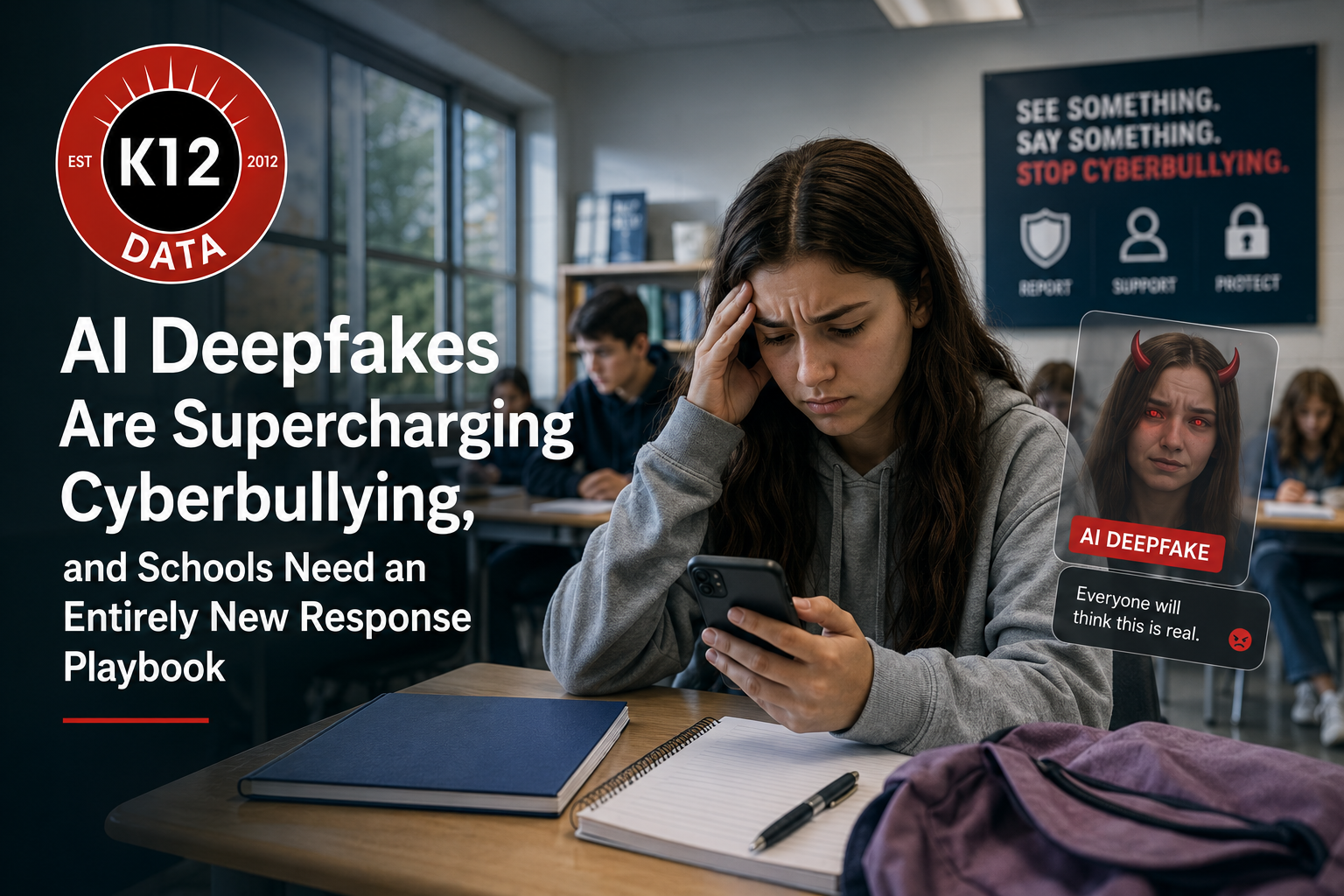
AI-generated deepfakes are supercharging cyberbullying, and experts say schools need to focus on prevention, creating urgent new demand for student safety infrastructure.
AI Deepfakes Are Supercharging Cyberbullying, and Schools Need an Entirely New Response Playbook
Cyberbullying is not a new problem for K-12 districts, but the tools behind it have changed faster than most districts' response protocols have kept pace. AI-generated deepfakes, realistic fabricated images, audio, and video, are now being used to harass, humiliate, and threaten students in ways that traditional cyberbullying policy was never built to address. Education researchers are direct about where the focus needs to shift: prevention, not punishment, since by the time a deepfake has circulated among a student body, meaningful harm has often already occurred regardless of whatever disciplinary consequence eventually follows.
This is a genuinely urgent, current problem for districts, and it is creating real demand for a category of student safety infrastructure, staff training, and technology most districts have never needed to build before.
Why Deepfakes Represent a Genuinely Different Threat
Traditional cyberbullying, even when it involved manipulated images or screenshots, generally required some real underlying material to distort. AI deepfake tools have removed that requirement entirely, allowing a student to generate a convincing fabricated image or video of a classmate doing or saying something that never happened, using nothing more than a few photos scraped from social media and freely available generative AI tools. This dramatically lowers the barrier to creating genuinely damaging content, and it means the content itself can be entirely fictional while still causing real, severe harm to the student being targeted.
This also means traditional approaches to verifying and addressing cyberbullying incidents, which often depended on establishing what actually happened, are considerably less useful when the entire incident may be based on content that never happened at all. Investigating a deepfake incident requires different technical literacy than investigating a traditional cyberbullying complaint, since staff need at least a basic understanding of how this content gets created and shared to respond effectively.
Why Prevention Has to Be the Focus
Once a deepfake begins circulating among a student body, meaningful harm has typically already occurred, regardless of how quickly a district identifies and addresses the source. This is precisely why researchers are emphasizing prevention over punishment as the correct strategic focus, since a purely disciplinary response, however appropriate for the student who created the content, does nothing to prevent the next incident or address the psychological harm already experienced by the targeted student.
"Deepfakes Are Supercharging Cyberbullying. How Should Schools Respond? The focus should be on prevention, not punishment, experts say."
Effective prevention requires genuine digital literacy education addressing AI-generated content specifically, not just traditional digital citizenship curriculum that predates this specific threat. Students need to understand both how to identify potentially fabricated content and the real, serious consequences of creating and sharing it, framed in a way that resonates with how students actually experience social pressure and peer dynamics rather than abstract policy language.
The New Staff Roles This Creates
Districts responding seriously to this threat are having to build genuinely new capability across several roles simultaneously. Title IX coordinators and student safety officers need updated training specifically addressing AI-generated content, since existing training built around traditional cyberbullying and harassment scenarios does not fully prepare staff for the specific technical and psychological dynamics of deepfake-based incidents. School counselors need updated frameworks for supporting students who have been targeted by fabricated content, since the psychological harm of a deepfake can differ meaningfully from harm caused by genuine, if embarrassing, real content.
Technology directors are increasingly being pulled into student safety conversations in a way that has not traditionally been part of their role, since identifying and addressing deepfake content often requires technical capability beyond what counselors or administrators typically possess independently. This creates a genuinely new cross-functional coordination requirement, similar in structure to other emerging K-12 challenges where a threat spans traditional departmental boundaries.
What Districts Are Actually Doing Right Now
Districts moving fastest on this are building specific incident response protocols for deepfake-related cyberbullying, distinct from general cyberbullying policy, since the technical and psychological dynamics genuinely differ enough to warrant a dedicated response framework. This includes clear guidance on how to document and report suspected deepfake content, coordination protocols between technology staff and student support staff, and updated family communication templates that can explain this specific threat to parents who may not fully understand how AI-generated content works.
Some districts are also investing in detection tools designed to help identify AI-generated or manipulated media, though this remains a genuinely difficult technical problem given how quickly deepfake generation technology continues to improve relative to detection capability, meaning policy and education-based prevention will likely remain the more reliable strategy for the foreseeable future regardless of how detection tools continue to develop.
Why This Creates Real Vendor Opportunity
Districts navigating this shift need genuinely specific resources: training programs built specifically around AI-generated content and deepfake awareness, updated policy templates addressing this specific threat category, and technology tools that can help identify and document incidents when they occur. Vendors offering generic cyberbullying or digital citizenship programming that has not been updated to address this specific, rapidly evolving threat are increasingly less relevant to what districts actually need right now.
This is a genuinely urgent, current purchasing conversation for districts, not a theoretical future need, since deepfake-related incidents are already occurring in schools nationwide and districts without an updated response framework are managing these incidents reactively, often for the first time, without established protocols to guide their response.
A Concrete Scenario Worth Walking Through
Consider a middle school where a student uses a widely available AI image generator to create a fabricated, sexually suggestive image of a classmate, using only a photo pulled from that classmate's public social media profile. The image circulates through group chats within hours, reaching a substantial share of the grade level before any adult becomes aware of it. By the time a teacher or counselor learns what has happened, the targeted student has already experienced real, severe social and psychological harm, regardless of the fact that the image itself depicts something that never occurred.
The district's response in this scenario involves considerably more than traditional disciplinary action against the student who created the image, though that remains an important component. It requires immediate support for the targeted student, who may be experiencing genuine trauma comparable to that of an actual privacy violation despite the fabricated nature of the content. It requires a technical process for documenting and, where possible, removing the circulating content. And it requires broader communication to the affected grade level or school community, calibrated carefully to address the incident without amplifying its reach further through well-intentioned but poorly executed communication.
This is not a hypothetical scenario. Versions of it are playing out in schools across the country as AI image and video generation tools become more accessible and more difficult to distinguish from genuine content, and districts without an established response protocol for this specific scenario are managing it reactively, improvising a response in real time while a targeted student experiences acute, ongoing harm.
The Legal Landscape Districts Are Still Catching Up To
State and federal law addressing AI-generated deepfake content specifically, as opposed to traditional harassment or bullying more generally, remains genuinely underdeveloped relative to how quickly this technology has become accessible to students. Some states have begun passing specific legislation addressing AI-generated intimate imagery involving minors, treating it with comparable severity to genuine child sexual abuse material given the real psychological harm inflicted regardless of the content's fabricated nature. Districts need to understand their specific state's current legal framework, since obligations around reporting, law enforcement involvement, and disciplinary consequences can vary considerably and are actively evolving as more states pass legislation specifically addressing this threat.
This legal uncertainty adds genuine complexity to district response protocols, since administrators need to understand not just their own disciplinary policy but their specific legal obligations, which may include mandatory reporting requirements that did not exist even a year or two ago in many states. Districts without clear legal guidance on this specific, evolving landscape risk either under-responding to a genuinely serious legal matter or over-responding in ways that create their own legal exposure through improper handling of a sensitive incident.
Why Traditional Digital Citizenship Curriculum Falls Short
Most existing digital citizenship curriculum was developed before generative AI tools became widely accessible to students, and its underlying assumptions, that manipulated content requires real underlying material and some meaningful technical skill to create convincingly, no longer hold. Students today can generate genuinely convincing fabricated content in minutes using free, widely available tools, with no meaningful technical skill required beyond basic familiarity with a consumer application.
This means digital citizenship curriculum needs genuine updating, not just supplementation, to address the specific reality that fabricated content can now be created by nearly any student with a smartphone and an internet connection. Effective updated curriculum needs to address both the technical reality of how easily this content can be created and the specific severity of harm it can cause, framed in language that resonates with how students actually understand social consequences and peer dynamics rather than abstract policy language borrowed from adult legal frameworks.
The Detection Technology Question Worth Understanding
Districts investing in AI content detection tools should understand this remains a genuinely difficult and rapidly evolving technical problem, with detection capability frequently lagging behind generation technology's continued improvement. A detection tool that reliably identifies AI-generated content today may prove considerably less reliable against next year's generation of more sophisticated tools, which means districts should not treat detection technology as a complete solution but rather as one component of a broader strategy that also depends heavily on policy, education, and reporting infrastructure that does not depend entirely on technical detection succeeding reliably.
This is worth communicating clearly to school boards and families evaluating district investment in this space, since detection technology alone, however sophisticated, cannot fully substitute for the prevention-focused education and clear reporting protocols that represent the more durable, technology-independent foundation of an effective response strategy.
A Broader Pattern of New Frontline Roles Emerging This Year
This dynamic, a previously settled role suddenly needing genuinely new capability due to an emerging technology threat, is showing up across sectors this year. Higher education is facing a related institutional pressure too, since the new Workforce Pell Grant program is creating genuine urgency for community colleges racing to get eligible programs approved. Healthcare is navigating a related emerging challenge too, since rising healthcare unionization is forcing practice leaders into unfamiliar legal territory they don't yet have a playbook for.
Government agencies are facing a strikingly similar dynamic from a different technical direction, since escalating cyberattacks on water systems are making public works officials a genuinely new cybersecurity frontline. And K-12 hiring reflects a related generational shift too, since Gen Z teaching candidates increasingly expect a modern, fast hiring process and are choosing districts accordingly.
AI deepfakes have changed what cyberbullying actually looks like faster than most district policy has caught up, and the districts responding most effectively are treating this as a genuine, current student safety priority requiring new staff training, updated policy, and cross-functional coordination between technology and student support staff. Vendors who can reach the Title IX coordinators, student safety officers, and technology directors now building this response capability, with contact data current enough to reflect who actually owns this emerging responsibility, are stepping into a genuinely urgent conversation most competitors have not yet fully mapped.
Ready to reach the student safety and technology leaders navigating this emerging threat? Build a verified K-12 database, or buy a school email list, with K12 Data today.