
 0
0

There are 0 items in your cart: Cart Subtotal: $ 0.00
Districts Are Turning to Marketing to Fight Declining Enrollment, and It's Creating a New Buyer

 The K12 Marketplace
  0
0
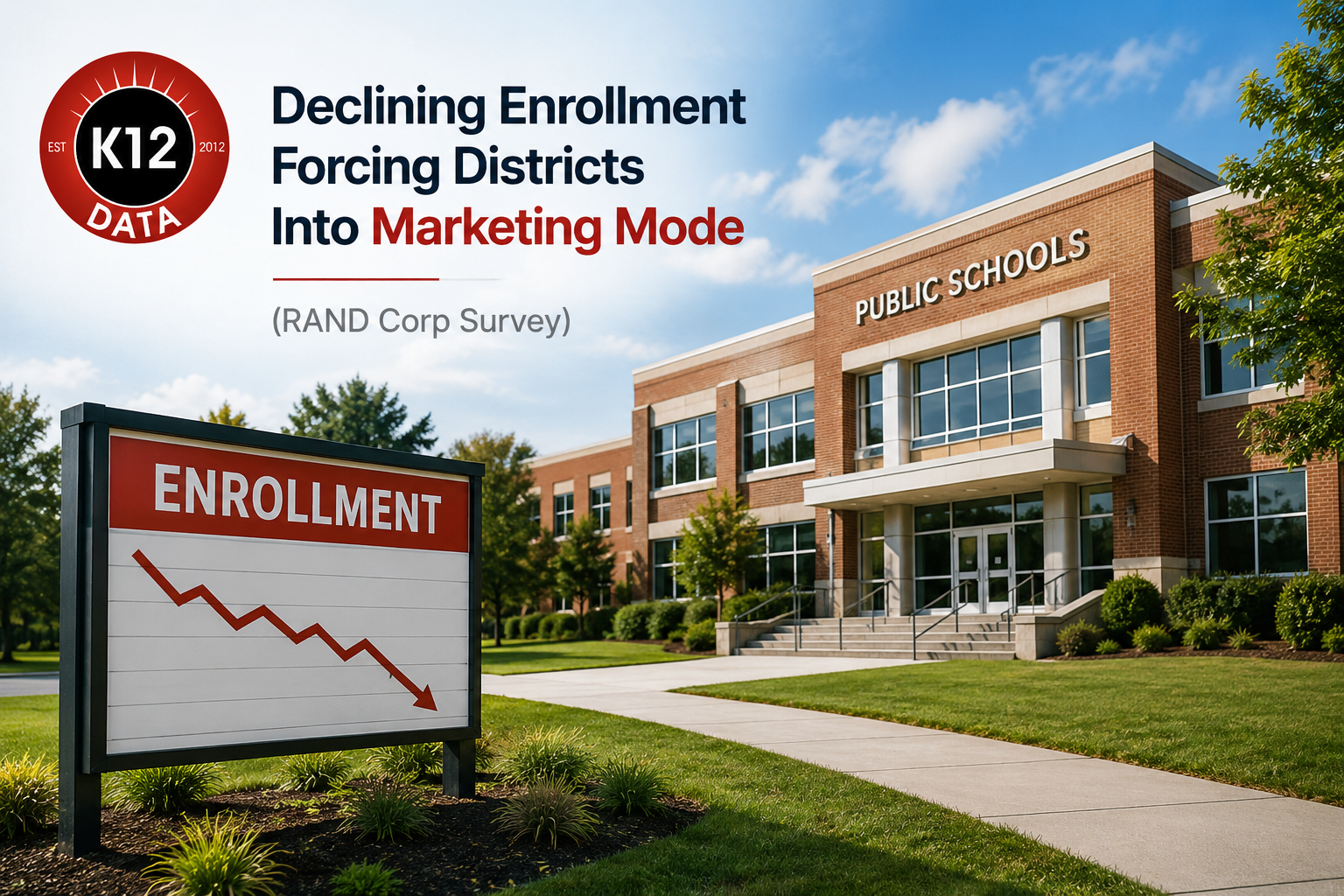
A new Rand Corp survey finds districts are turning to marketing campaigns and expanded pre-K services to fight declining enrollment, creating a genuinely new category of K-12 buyer.
Districts Are Turning to Marketing to Fight Declining Enrollment, and It's Creating a New Buyer
Enrollment decline has been a known, well-documented pressure on K-12 districts for years, driven by falling birth rates, competition from school choice options, and shifting migration patterns. What is genuinely new is how districts are responding to it. A recent Rand Corporation survey finds districts increasingly turning to marketing campaigns and expanded pre-K services specifically to attract and retain students, a response that would have seemed unusual for a public school system even five years ago, when enrollment was something districts managed passively rather than something they actively competed for.
This shift matters directly for anyone selling into K-12, because it is creating a genuinely new category of district decision-maker, one focused explicitly on marketing and family recruitment, a function most districts have never staffed or budgeted for as a distinct line item before.
Why Districts Are Suddenly Thinking Like Marketers
Every state and the District of Columbia experienced at least a six percent enrollment drop between 2012 and 2024, driven substantially by declining birth rates that no district-level policy can reverse. Layered on top of that demographic reality is genuine competition: school choice programs, interstate migration, and shifting immigration patterns are all pulling students away from a growing number of traditional public districts, creating a competitive dynamic districts have historically not needed to navigate with any real sophistication.
The Rand survey's finding that districts are turning to marketing campaigns is a direct response to this new competitive reality. A district that used to simply exist, confident that geographic boundaries would deliver a stable base of students year after year, now has to actively make the case for why a family should choose it, whether that family is choosing between public and private options, between traditional public and charter schools, or simply deciding whether to stay in the district at all given increasingly mobile family circumstances.
Why Pre-K Expansion Is Part of the Same Strategy
Expanding pre-K programming is not simply an educational equity initiative, though it certainly serves that purpose too. It is increasingly a direct enrollment strategy, since families choosing where to enroll a child at age four are, in practice, making an early decision about where that same child will likely continue through elementary school and beyond. Districts investing in pre-K expansion are effectively investing in a longer-term enrollment pipeline, capturing families earlier in a way that pays off across many subsequent years of per-pupil funding.
This dual purpose, genuine early childhood education value combined with real strategic enrollment benefit, is making pre-K expansion a genuinely popular investment among districts facing enrollment pressure, and it is creating real, near-term purchasing decisions around early childhood curriculum, facilities, and staffing that a district's traditional budget planning process has not always prioritized at this level before.
"Marketing campaigns and expanded pre-K services to bring in more students, according to a new Rand Corp survey."
The New Decision-Maker This Creates
Districts investing seriously in enrollment marketing are, in a growing number of cases, creating dedicated communications or enrollment marketing roles, sometimes a new hire, sometimes an existing communications director's role formally expanded to include enrollment strategy as an explicit responsibility. This is a genuinely new function for most districts, distinct from the traditional public relations and crisis communications work district communications offices have historically handled, and it requires a different skill set entirely, closer to consumer marketing than to traditional public-sector communications.
This new role represents a real, identifiable buyer for marketing technology, family engagement platforms, and enrollment-focused creative and campaign services, a category of vendor relationship many districts have never had reason to build out before, since marketing simply was not something districts needed to invest in seriously until enrollment pressure made it a genuine strategic necessity rather than a nice-to-have communications upgrade.
Why This Creates Urgency for Vendors Right Now
Districts standing up this function for the first time are actively researching vendors, platforms, and strategies right now, often without a clear internal precedent for what a successful district enrollment marketing campaign actually looks like. This is a genuine window of opportunity for vendors who can offer both the technology and the strategic guidance a district new to this function needs, since many of these districts are not simply looking for a tool. They are looking for a partner who can help them think through an entirely new competitive challenge their existing staff has limited direct experience navigating.
Vendors who can speak specifically to K-12 enrollment marketing, rather than generic marketing services adapted loosely for an education audience, have a real opportunity to build trust with districts navigating this shift for the first time, particularly districts in fast-declining-enrollment regions where this pressure is most acute and the need for outside expertise is most urgent.
Which Districts Face This Pressure Most Acutely
Districts in regions experiencing the steepest demographic decline, and districts facing the most direct competition from expanding school choice programs, are the ones investing most aggressively in this new marketing function right now. Urban districts losing families to suburban migration, and suburban districts facing new competition from expanding charter and private options, both represent genuine near-term opportunity for vendors serving this space, though the specific marketing challenge each faces differs meaningfully depending on their particular competitive situation.
Rural districts face a related but structurally different version of this pressure, often unable to compete on the same marketing terms as better-resourced districts but increasingly recognizing that even modest, well-targeted family engagement and pre-K investment can meaningfully affect enrollment trajectory in a small district where even a handful of additional students represents real, proportionally significant funding impact.
A Concrete Scenario Worth Walking Through
Consider a mid-size suburban district that has seen enrollment decline roughly eight percent over the past five years, driven by a combination of falling local birth rates and the recent opening of two new charter schools within its boundaries. For decades, this district never needed to think about family choice at all, since geographic assignment guaranteed enrollment regardless of what the district actually offered. Now, families are making an active choice every year, weighing the district against charter alternatives, and the district's traditional communications approach, occasional newsletters and a static website, was never built to make a compelling, persuasive case for why a family should choose to stay.
The district's response, hiring a dedicated enrollment marketing coordinator and launching its first genuine family recruitment campaign, represents exactly the kind of shift playing out in districts nationwide right now. This is not a hypothetical scenario. Versions of it are unfolding in school board meetings and district budget planning sessions across the country this year, as declining enrollment translates directly into declining per-pupil funding, giving districts genuine financial urgency behind what might otherwise be treated as a lower-priority communications upgrade.
What Genuinely Effective District Marketing Looks Like
Districts succeeding at this new function are not simply running generic advertising campaigns borrowed from corporate marketing playbooks. They are building genuinely authentic, locally specific messaging that speaks directly to what makes their particular schools distinctive, whether that is strong academic outcomes, specific program offerings, extracurricular strength, or simply a genuine sense of community many families value highly when evaluating where to enroll their children. Districts that treat this as a copy-paste exercise, running the same generic messaging any district could use, are seeing considerably weaker results than districts investing in genuinely specific, locally grounded campaigns.
This authenticity requirement means district enrollment marketing cannot simply be outsourced wholesale to a generic marketing agency unfamiliar with the specific district's community and priorities. It requires genuine collaboration between district leadership, who understand the community and the district's actual strengths, and marketing expertise, who understand how to translate that understanding into a genuinely compelling campaign. Vendors who can offer this kind of collaborative approach, rather than a one-size-fits-all campaign template, are far better positioned to deliver results districts can actually measure and defend to their own school boards.
The Data Districts Need to Make This Work
Effective enrollment marketing requires districts to understand not just their own enrollment trends, but the broader competitive landscape they are actually operating within, including where families who leave the district are choosing to go instead, and what specifically is drawing them there. Districts investing in genuine enrollment strategy are increasingly seeking out data and analysis capability they have not traditionally needed, from competitive landscape analysis to family survey and feedback tools that help identify specifically why families are making the choices they are making.
This creates real, adjacent demand beyond marketing services themselves, extending into data analysis, family engagement platforms, and survey tools specifically built to help districts understand their own competitive position with genuine rigor, rather than guessing at what families actually value based on anecdotal school board feedback alone.
Building This Function Without Starting From Zero
Districts standing up enrollment marketing for the first time do not need to build every capability internally before launching a genuine effort. Partnering with vendors who bring both platform capability and genuine K-12 marketing expertise allows a district to move considerably faster than building an internal team from scratch, particularly for districts where budget constraints make a full internal hire genuinely difficult to justify even given the real financial stakes tied to enrollment decline.
This partnership model also gives districts access to broader pattern recognition across multiple districts facing similar challenges, insight an individual district's own limited experience cannot provide on its own. A vendor who has helped a dozen similar districts navigate this exact transition brings genuine, transferable expertise that a district building this function in isolation, learning entirely through its own trial and error, simply cannot replicate as efficiently or as quickly.
A Broader Pattern of Institutions Turning to New Strategies
This dynamic, an institution traditionally insulated from competitive pressure suddenly needing genuinely new strategic capability, is showing up across sectors this year. Higher education institutions can find practical guidance directly, since College Data's FAQ page addresses many of the same underlying data quality and sourcing questions that apply to any vendor evaluating a genuinely new, emerging marketing function like this one. Healthcare organizations face a comparable expansion of strategic need too, and Physician Data's glossary offers useful grounding in exactly the kind of terminology shift that accompanies a role taking on new strategic responsibility for the first time.
Government agencies are navigating a related organizational shift too, since state and local governments are quietly restructuring who runs technology, with digital service leaders winning the top job in a growing number of jurisdictions. And K-12 hiring reflects a version of this same pressure from a different angle, since the collapse in applicants per posting is forcing districts to rethink their entire hiring strategy the same way declining enrollment is forcing them to rethink recruitment.
Districts have not historically needed to think like marketers, but declining enrollment and expanding competition have made that shift a genuine strategic necessity rather than an optional upgrade. Vendors reaching the communications directors and enrollment strategists now building this function for the first time, with contact data that reflects this genuinely new role accurately, are stepping into a purchasing conversation most competitors have not yet identified as a distinct opportunity. The districts that invest seriously in this capability now, while it remains a genuine competitive differentiator rather than a baseline expectation every district has already matched, stand to benefit disproportionately compared to those still treating enrollment as something that simply happens to them rather than something they can actively influence.
Ready to reach the district leaders building out enrollment marketing strategy? Build a verified K-12 database, or buy a school email list, with K12 Data today.