
 0
0

There are 0 items in your cart: Cart Subtotal: $ 0.00
New York City Just Paused Student-Facing AI for a Full Year, and Districts Everywhere Are Rethinking How They Vet Ed-Tech

 The K12 Marketplace
  0
0
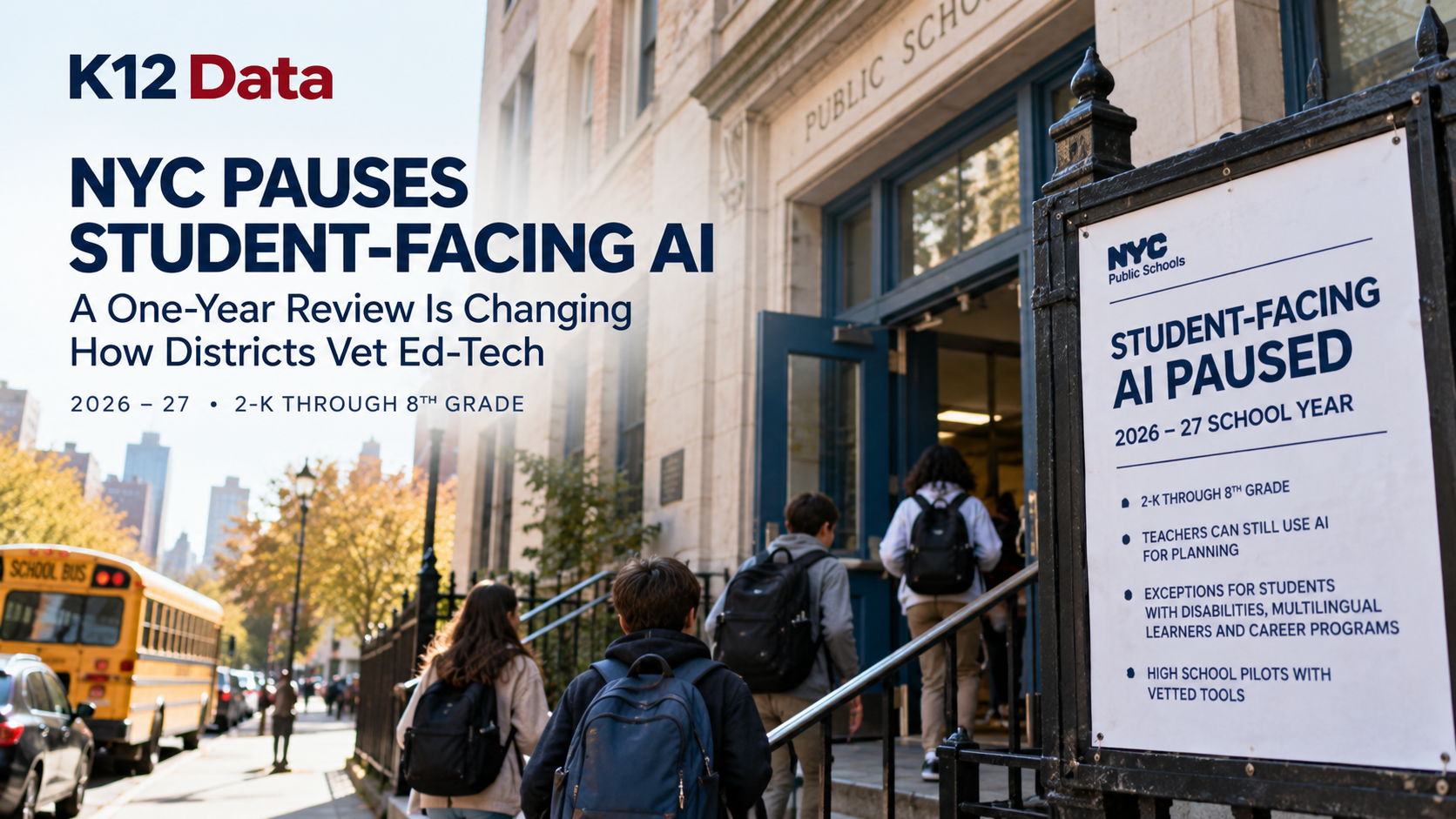
NYC's one-year pause on student-facing AI for grades 2-K through 8 is pushing districts nationwide to build clearer processes for evaluating the technology they bring into classrooms.
New York City Just Paused Student-Facing AI for a Full Year, and Districts Everywhere Are Rethinking How They Vet Ed-Tech
The Largest School System in the Country Hits Pause
On September 2, 2026, New York City Mayor Zohran Mamdani and NYC Public Schools announced a one-year pause on student-facing AI tools for students from 2-K through eighth grade. The pause covers the 2026-27 school year and applies to roughly 600,000 students, about two-thirds of the city's public school enrollment. It is the broadest generative AI moratorium any U.S. school system has put in place, and because of the size of the district, it is getting attention far beyond the five boroughs.
The details matter, because the headline version of this story is easy to misread. Teachers can still use AI for instructional planning and operational tasks. Students with disabilities, multilingual learners, and students in career readiness programs receive exceptions. The policy also sets daily screen time caps of 30 minutes for grades 2 through 5 and 45 minutes for grades 6 through 8. And while younger students are paused, five AI programs will be piloted in high schools using vetted tools.
A Review, Not a Retreat
The most useful part of the announcement for other districts is what happens during the pause. NYC says it will conduct an exhaustive review of all technology tools during the year. In other words, the district is using the year to build the evaluation process it wishes it had before AI arrived in classrooms, not to walk away from technology.
Reactions have been split in the way you would expect, and both sides are making points worth hearing. InnovateEDU CEO Erin Mote called the pause an opportunity to build evidence on which tools actually work. Digital Promise CEO Jean-Claude Brizard cautioned that AI is already pervasive in students' lives. The AI Moratorium Coalition said the policy does not go far enough and wants a longer pause. For district leaders watching from elsewhere, that range of opinion is itself useful: it shows how many stakeholders will have a voice in any local decision.
What Other Districts Are Taking From It
Very few districts will copy New York's policy exactly. Most do not have a mayor-led initiative, a citywide screen policy, or the capacity to run a system-wide technology review. But many are taking a quieter lesson from it: that now is the time to formalize how ed-tech gets approved. Questions that used to be handled informally are moving into written process. Who reviews a tool before a school pilots it? What evidence of effectiveness is required? What does the vendor commit to regarding student data? Who signs off?
That is a significant shift for the people who sit at the center of those decisions. Chief technology officers and technology directors are being asked to produce review frameworks. Curriculum directors and assistant superintendents are being asked to define what instructional value looks like. Elementary and middle school principals, whose students are directly in the scope of the NYC pause, are fielding questions from parents. Superintendents are preparing for board conversations. Each of these roles is now an active participant in how technology is evaluated.
What It Means for Companies That Sell to Schools
For ed-tech companies, the NYC announcement is a signal to prepare, not to panic. The vendors best positioned for the next year are the ones who can hand a district a clear, evidence-based answer to the questions above. That means documented learning outcomes, plain-language data privacy terms, and a straightforward description of how teachers stay in control. A company that can supply that package will have an easier conversation in a district that is building its first formal review process than a company that cannot.
It also means the audience for outreach is shifting. In many districts, the person who used to approve a pilot informally is now one voice in a larger review. Reaching only a single contact may no longer be enough. Reaching the technology director, the curriculum lead, and the principals together, with a message that speaks to each of their concerns, is a stronger approach. Verified, role-specific contact data is what makes that kind of outreach possible.
Why the Exceptions Deserve Attention
The exceptions written into the NYC policy are as instructive as the pause itself. Students with disabilities, multilingual learners, and students in career readiness programs can still use approved tools, which reflects a recognition that some AI-supported tools function as access technology for these students. District leaders elsewhere will likely follow that logic, drawing a distinction between general-purpose student AI and tools designed to support specific learners. Special education directors, English learner coordinators, and career and technical education leaders are therefore part of the review conversation, not just the technology office.
The high school pilots point the same direction. Five programs will be tested with vetted tools, which means the district will gather real evidence about what works with older students before making broader decisions. For vendors, the lesson is that evidence collected in a structured pilot carries more weight than a polished demo. For districts, it is a model worth considering: start small, define what success looks like, and measure it.
What Happens After the Pause
Nobody outside the district can predict exactly how the year will end, but the shape of the review is clear enough to plan around. Findings will be shared, board members will ask questions, and other large systems will compare their own policies against what New York learns. Some will move toward limited, well-defined uses. Others will extend their own pauses. Most will land somewhere in between, with clearer approval steps than they have today.
That uncertainty is exactly why relationships matter. The district leaders who will interpret the findings are the same people who are being asked to build review processes now. Companies that take the time to understand how those leaders think, and that show up with useful, honest information instead of a hard sell, will be remembered when the decisions are made.
A Practical Checklist for District Teams
For district teams that want to turn the news into action, a short working list helps. Inventory every tool that touches student data, including the ones that arrived through individual teacher requests. Identify who currently approves new tools and whether that process is documented. Draft a one-page summary of your expectations for effectiveness evidence and data privacy. Share it with the principals and curriculum leaders who field questions from families. Finally, schedule a review point in the spring so the policy stays current as the technology and the guidance evolve.
What Parents and Principals Are Hearing
Principals in the affected grades are the ones who will hear the reaction first. Some parents will welcome the pause and the screen limits. Others will wonder whether their children are being left behind. Principals who have a clear, honest explanation ready, grounded in the idea that the district is taking a year to evaluate before expanding, will have an easier time. Districts elsewhere are watching how those conversations go, and many are quietly preparing their own talking points in case the question reaches them next. Sharing those preparations across principals, curriculum leaders, and the technology office keeps the message consistent from school to school.
The Pattern Across Education
Education leaders in every sector are asking some version of this question. Districts rethinking how they evaluate technology are also rethinking how they build their teams, a pressure explored in this piece on a governor's push to ban H-1B visas for teachers, which highlights why districts need stronger domestic candidate pipelines. Colleges are working through their own planning questions, and anyone who wants to reach campus decision-makers can start with College Data. Across all of these, the common thread is that institutions are moving from informal habits to deliberate process.
How to Prepare This School Year
If you work in or sell to K-12, there are a few practical steps worth taking now. Make a list of the roles involved in technology decisions at the districts you serve, because the list is longer than it used to be. Prepare materials that answer effectiveness, privacy, and teacher control directly. Pay attention to district board agendas, where new review processes are often introduced. And treat the next twelve months as a period of clarification, because the review New York City is running will produce findings other districts will read closely.
The K12 Data glossary is a handy reference for the job titles and terms that come up in these conversations, especially if you are new to selling into education.
Frequently Asked Questions
Did New York City ban AI in schools?
Not entirely. New York City paused student-facing AI tools for grades 2-K through 8 for the 2026-27 school year, affecting about 600,000 students. Teachers can still use AI for planning and operations, exceptions exist for students with disabilities and multilingual learners, and five vetted AI programs will be piloted in high schools.
Why did NYC pause student AI use?
City leaders said they want time to review all technology tools in schools and build evidence about what works before expanding student-facing AI. The pause also comes with daily screen time limits of 30 minutes for grades 2 through 5 and 45 minutes for grades 6 through 8.
Who decides which ed-tech tools a school district approves?
It varies by district, but technology directors and chief technology officers, curriculum directors, assistant superintendents, principals, and the superintendent usually share the decision, with school boards approving larger contracts.
Reach the People Building Your Next Review Process
K12 Data maintains verified contacts for chief technology officers, technology directors, curriculum directors, superintendents, and elementary and middle school principals nationwide. If your product fits where district ed-tech review is heading, build a targeted list and buy a school email list filtered to the exact roles you need, so you reach the people shaping these decisions while the conversation is still open.