
 0
0

There are 0 items in your cart: Cart Subtotal: $ 0.00
One in Four Algebra-Ready Eighth Graders Skips the Course Even When It Is Offered, and Districts Can Fix That This Spring

 The K12 Marketplace
  0
0
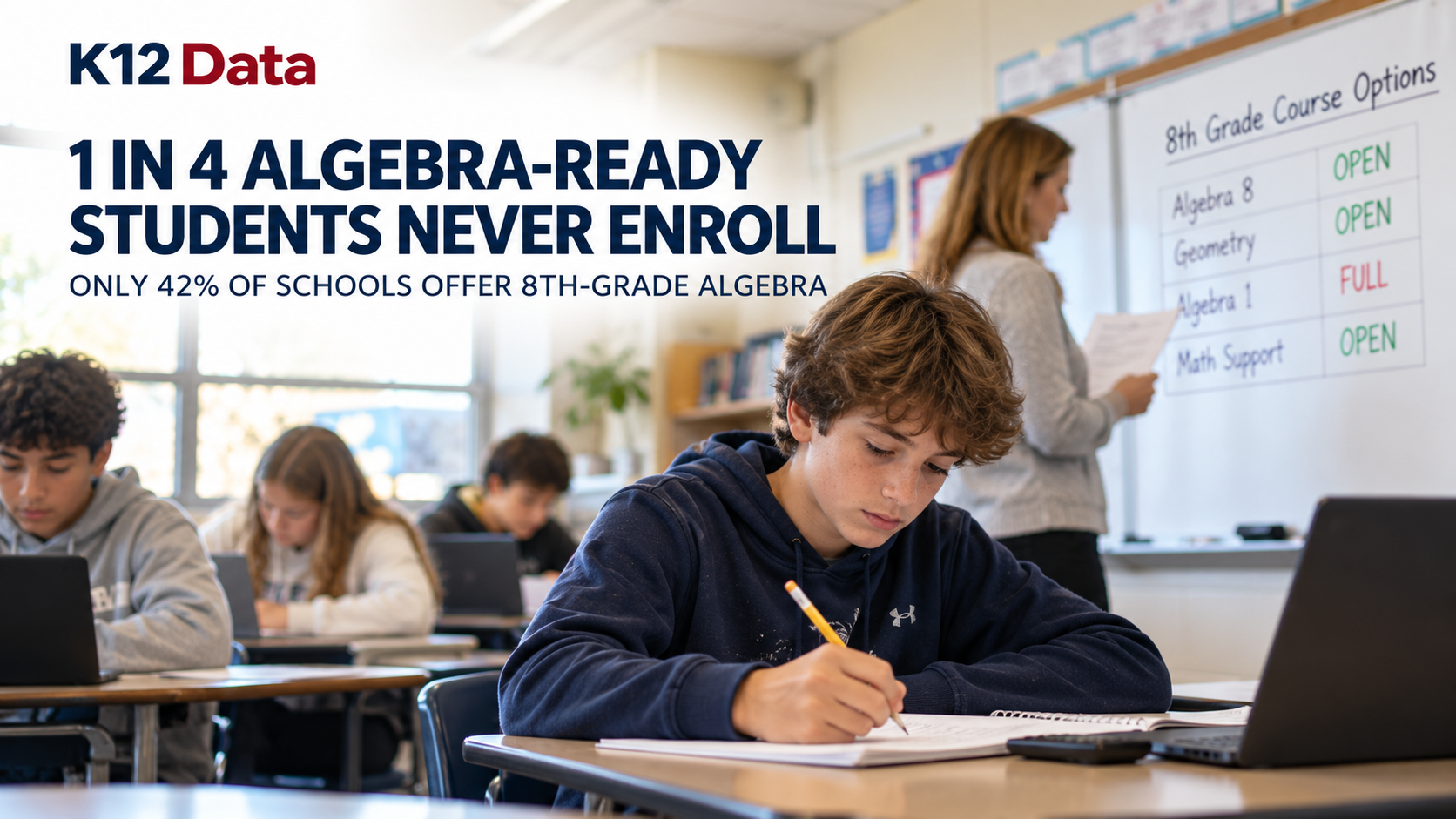
NWEA's new study finds a quarter of students are ready for 8th grade algebra, yet many never enroll and fewer than half of schools offer it. Here is what district leaders can do.
One in Four Algebra-Ready Eighth Graders Skips the Course Even When It Is Offered, and Districts Can Fix That This Spring
New NWEA research shows about 25 percent of students are ready for eighth-grade algebra, nearly one in four of those students never enroll, and only 42 percent of schools offer the course at all. The fix is mostly data, scheduling, and a better conversation with families.
Key Takeaways
• NWEA studied 55,000 students and found about 25 percent appear ready for eighth-grade algebra.
• Nearly one in four of those ready students did not enroll in the course even when their school offered it.
• Only 42 percent of schools represented in the data offer eighth-grade algebra at all.
• Students in the top half of the math distribution did better when they took algebra in eighth grade, while students in the bottom half scored about the same in eighth or ninth grade and need added support.
A Placement Gap Hiding in Plain Sight
Most conversations about math recovery focus on what happens inside the classroom. A new study from NWEA points at something earlier and more fixable: who gets into the right class in the first place. Released on August 18, 2026 and covered widely in the weeks since, the research followed 55,000 students nationally, pairing their seventh-grade MAP Growth math scores with their MAP Growth Algebra results in eighth or ninth grade. The headline finding is easy to state. About 25 percent of students appear ready for eighth-grade algebra, and nearly one in four of those ready students did not enroll in it, even though their school offered the course.
That is a placement problem, not a learning problem. These students have shown, on a standard measure, that they are prepared. What stands between them and the course is a schedule, a default setting, a counselor's rule of thumb, or a family conversation that never happened. Those are all things a district can change without buying a single new program.
These students have shown they are ready. The barrier is a schedule, a default, or a conversation that never happened.
Access Is the Other Half of the Story
The second number is just as important. Only 42 percent of schools in the data offer eighth-grade algebra. For a student in the other 58 percent, readiness does not matter, because the course is not there. NWEA's recommendation is to expand access for ready students, including through alternatives such as online options with guidance and support, so that a small school or a rural campus without an algebra teacher is not a dead end.
That recommendation opens a practical door. A district that cannot staff a section of algebra in every middle school can still create a pathway through a shared online course, a regional program, or a teacher who travels between campuses. The research does not claim any one model is best. It simply makes clear that a ready student with no option is the most avoidable loss in the data.
Timing Matters, but Readiness Matters More
NWEA titled its release with the finding that algebra timing matters but readiness matters more, and the details explain why. Students in the top half of the math distribution did better in algebra when they took it in eighth grade instead of ninth. For them, waiting costs something. Students in the bottom half scored about the same whether they took the course in eighth or ninth grade, and both groups stayed below the algebra proficiency benchmark.
In other words, pushing every student into eighth-grade algebra is not the answer, and holding everyone back until ninth grade is not the answer either. NWEA researcher Megan Kuhfeld, who directs growth modeling and data analytics, put it this way: there is no one-size-fits-all approach to that timing. The research points to two tracks. For students who are ready, expand access. For students who are not yet ready, strengthen support through earlier pre-algebra instruction, targeted intervention, additional learning time, and strong eighth-grade math pathways.
Why This Is an Upbeat Story for Districts
It is easy to read a study about unmet potential as bad news. A better reading is that the gap is cheap to close compared with most academic challenges. A district can pull its own seventh-grade MAP Growth data, identify every student who looks ready for algebra, and compare that list to current enrollment. The students who are ready and not enrolled become a short, specific list. A counselor or a principal can call each family.
The surrounding data is encouraging as well. New NWEA numbers released last month showed sizable K-8 reading gains, which we covered in our look at the MAP Growth reading results. The College Board reported on September 29 that the class of 2026 posted a mean SAT total of 1045, up 16 points, with gains across demographic groups and in both reading and writing and math. Academic momentum is building, and algebra placement is one of the clearest places to turn it into longer-term opportunity.
What a District Can Do Before Spring Scheduling
Course placement for next year is decided in winter and spring, which makes the next few months the working window. A district can start with five moves.
First, run the data. Identify students whose seventh-grade math results suggest readiness for algebra and compare them to current eighth-grade course rosters. Second, review the default. If algebra requires an opt-in form or a teacher recommendation, ask how many ready students never receive either. Third, call the families. A short, personal conversation about what algebra in eighth grade opens up, including access to more advanced high school math and, for many students, a stronger path toward college-level coursework, changes decisions more reliably than a letter.
Fourth, plan the other group. For students who are close but not ready, build a bridge with pre-algebra support, small-group instruction, and extra time. Fifth, solve for access. If a campus cannot staff the course, explore an online option with in-person support or a shared section. These steps do not require new funding in every district, though they do require someone who owns the work.
The best algebra initiative may be a counselor with a list and a phone.
Measuring Progress Once Placement Changes
A placement change is only useful if it is tracked. Districts can follow three simple measures: the share of ready students enrolled in algebra, the share of those students who finish the year at or above grade-level expectations, and the share of close-but-not-ready students who reach readiness after a year of support. Reviewing these numbers each term, rather than once a year, lets teams adjust before the next schedule is built.
Disaggregating the data by school, grade, and student group is equally important. NWEA found the gap affects ready students broadly, so a district that looks only at averages may miss a campus where nearly every ready student is left out. A clear picture lets leaders target outreach where it will matter most.
Who Owns Algebra Placement
Ask who decides algebra placement in a school district and the answer changes from place to place. In many systems the curriculum director or a secondary math coordinator sets policy. Middle school principals and counselors carry it out. Assistant superintendents for instruction approve the course catalog. Instructional coaches shape what support looks like. School boards weigh in when a policy change affects equity and access. In small districts, a single administrator may hold several of those roles.
That spread is why outreach to this audience works best when it reaches both the district-level owner and the school-level leader. The district owner decides whether to change the policy. The school leader decides whether it works in practice. Companies that serve this space, whether they offer placement analytics, online algebra courses, pre-algebra interventions, tutoring, or teacher training, tend to see the best results when they speak to both.
The Teaching Capacity Question
Expanding access ultimately comes back to people. A district that adds algebra sections needs teachers certified and confident in the subject, and middle school math is a hard-to-fill assignment in many regions. Districts building that capacity can post math teaching openings for free on K12 Talent, which reaches educators across traditional, alternative, and accelerated pathways.
College readiness is the long view. Students who reach calculus or advanced statistics by senior year are better positioned for gateway courses in college, and College Data's FAQ is a useful starting point for anyone connecting the K-12 pipeline to higher education decision-makers.
How to Talk With Families About Eighth-Grade Algebra
Placement gaps often trace back to a conversation. Some families hear the word algebra and worry about workload, grades, or a student's confidence. Others never hear about the option at all, especially when information goes home only in a packet or a portal message. A simple script helps counselors and teachers: explain what the course is, show the student's own readiness data, describe the support available, and be clear about what happens next year if the student does or does not take it.
Districts that do this well tend to treat the conversation as an invitation rather than a requirement. They share the data in plain language, name a trusted adult who will check in during the first weeks, and make it easy to adjust the schedule if the fit is wrong. That approach respects families, and it gives ready students a real chance to say yes.
Questions Every Board Should Ask
School boards do not need to manage course schedules, but they can ask the questions that make the work visible. How many students in our district look ready for algebra by seventh grade? How many of them enrolled this year? Does every middle school offer the course, and if not, what is the alternative? What support do students receive who are close but not yet ready? When will we see the results?
Those five questions turn a research finding into a district goal. They also give administrators a reason to track the numbers and report them on a regular schedule, which is how a one-time review becomes a lasting practice.
What Vendors and Partners Should Do Next
For companies serving K-12 math, this research is a rare gift: a respected, independent finding that names the problem, quantifies it, and recommends solutions that map to products and services. Placement tools that use MAP Growth or similar data fit squarely under the recommendation to use data to guide placement. Online courses with guidance and support fit the access recommendation. Pre-algebra interventions, small-group tutoring, and extended learning time fit the support recommendation.
The pitch that works is specific. Show how many students in a typical district might be ready and not enrolled, explain what a pilot would cost in staff time, and offer to help the district measure results by the end of the year. District leaders respond to evidence they can take to a board.
If you want to reach the people who own this decision, K12 Data can help. Our school district email lists and K-12 database give you education contact data for every role in this story: a math curriculum director email list, a secondary math coordinator list, a middle school principal email list, a school counselor email list, an assistant superintendent email list, an instructional coach email list, a superintendent email list, and a school board member email list. If you are ready to buy school email list data, or want a K-12 marketing database filtered by role, state, and district size, build a targeted list here while spring scheduling decisions are still ahead.
Frequently Asked Questions
How many eighth graders are ready for algebra?
NWEA's analysis of 55,000 students found about 25 percent appear ready for eighth-grade algebra based on seventh-grade MAP Growth math results.
What percent of schools offer eighth-grade algebra?
Only 42 percent of the schools represented in NWEA's data offer eighth-grade algebra, which means many ready students have no course available.
Should every student take algebra in eighth grade?
No. NWEA found students in the top half of the math distribution did better taking it in eighth grade, while students in the bottom half scored about the same in eighth or ninth grade and need added support such as pre-algebra and targeted intervention.