
 0
0

There are 0 items in your cart: Cart Subtotal: $ 0.00
Real-Time List Building vs. the Quote-and-Wait Model: Why Speed Is a K-12 Data Quality Signal

 Marketing
  0
0
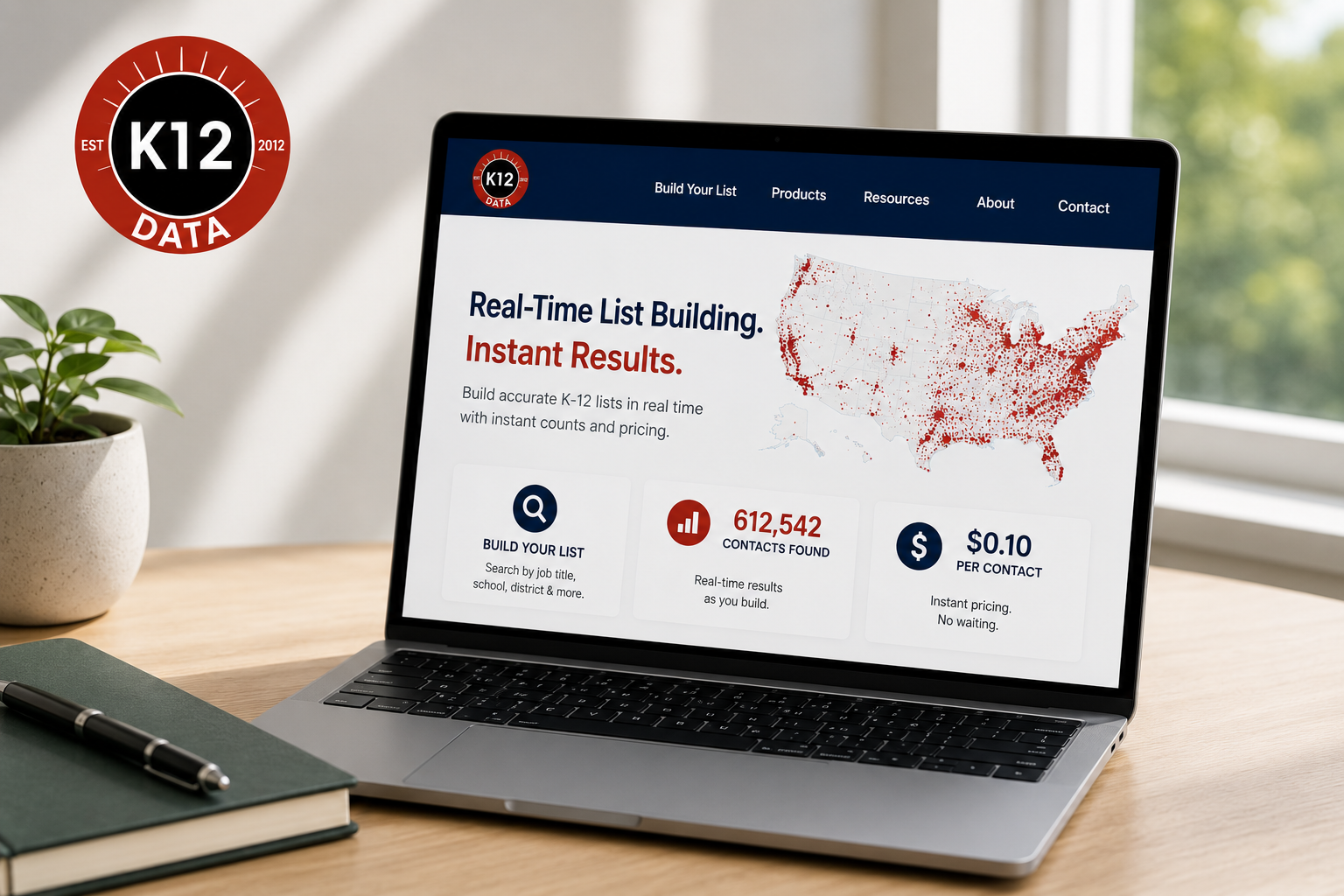
Most K-12 data vendors still make you call for a quote. Real-time list building and instant pricing is a genuine signal of data quality, not just a convenience feature.
Real-Time List Building vs. the Quote-and-Wait Model: Why Speed Is a K-12 Data Quality Signal
Call for a quote. Wait for a callback. Get a PDF proposal three days later. Negotiate counts over email for another week. This is still how a huge share of the K-12 contact data market operates in 2026, and most buyers have simply accepted it as normal because it is what every vendor in the space has always done. It is worth asking a more basic question: why does building a list still require a phone call at all, and what does it tell you about a vendor's data infrastructure when it does?
The answer is more revealing than most buyers realize. A vendor's pricing and delivery model is not just a convenience question. It is a direct window into how their underlying data is actually structured, and slow, manual, quote-based pricing is very often a symptom of a database that cannot support real-time querying in the first place.
Why Quote-Based Pricing Persists in This Market
The quote-and-wait model survives in K-12 data for a structural reason that has nothing to do with customer preference and everything to do with backend limitations. A vendor whose data lives in scattered spreadsheets, licensed feeds from multiple upstream sources, or a database that was never built for live filtering simply cannot generate an accurate real-time count without someone manually pulling and reconciling data behind the scenes. That manual reconciliation is exactly what is happening during the days a buyer spends waiting for a quote, even when the sales team frames it as a personalized consultation.
This matters because the same underlying limitation that makes real-time pricing impossible also makes real-time accuracy impossible. A database that cannot generate an instant, accurate count of superintendents in a given state almost certainly cannot maintain the kind of continuous verification needed to catch when one of those superintendents changes districts. The slow pricing process and the stale data problem come from the same root cause.
What Real-Time Actually Requires
Building a platform that can deliver instant counts and pricing requires a fundamentally different data architecture than a spreadsheet-based operation, and it is worth understanding what that architecture actually demands, because it directly explains why so few vendors have built it. It requires a single, unified, continuously maintained database rather than a patchwork of licensed feeds bolted together. It requires structured, standardized fields across the entire dataset, since messy or inconsistent data cannot be filtered reliably in real time no matter how good the underlying research was. And it requires ongoing investment in the platform itself, not just the underlying data, since a self-service tool has to be built, tested, and maintained as genuine software, not just exported as a one-time file, with real engineering resources behind it on an ongoing basis.
K12 Data built its Build a List platform specifically to solve this problem, giving customers the ability to build a custom list and see real-time counts and pricing without a single phone call, then import the results directly into a CRM in minutes rather than days. That platform only works because the underlying database is unified and continuously maintained in a way that supports live querying, which is precisely the infrastructure most quote-based competitors have never built.
The Hidden Cost of Waiting
The days spent waiting for a quote are not neutral. A marketing team with a campaign deadline loses real planning time to a process that adds no actual value, since the eventual list they receive is not meaingfully better for having been quoted manually rather than generated instantly. Worse, a manual quote process often means the buyer cannot iterate quickly, testing different segment sizes or criteria combinations before committing, because each adjustment requires another round trip through the same slow sales process.
This compounds during time-sensitive purchasing windows, which are increasingly common in B2B marketing generally. A vendor responding to a fast-moving news cycle, a policy change, or a seasonal campaign window cannot afford to spend a week waiting on a quote before launching outreach, and a real-time platform is often the only way to actually capitalize on a narrow window before it closes.
Speed as a Proxy for Data Quality
The connection between speed and quality is not a coincidence, and it is worth stating directly: a vendor that can show you real-time, accurate counts is demonstrating, in that exact moment, that their underlying data is clean, structured, and current enough to support live filtering without errors. A vendor that cannot do this is implicitly telling you something about the state of their data, whether or not their sales team frames it that way.
This is a genuinely useful heuristic for buyers evaluating an unfamiliar vendor. Ask to see a real-time count for a specific, narrow segment, such as technology directors in a particular state, while you are on the call. A vendor with real infrastructure can show you immediately. A vendor without it will need to get back to you, and that gap is not a minor inconvenience. It is a direct signal about what you are actually buying.
The Real-Time Test You Can Run Yourself
Buyers do not need to take a vendor's infrastructure claims on faith. There is a simple test that reveals the truth in minutes. Pick a genuinely narrow, specific segment, something like assistant principals in mid-size districts in a single state, and ask the vendor for an exact count while you are still on the call or in the chat. A vendor with real, unified infrastructure will return an accurate number essentially instantly, because the query runs directly against their live database. A vendor without that infrastructure will need to check with someone, pull a report, or get back to you later, and that delay is not a scheduling inconvenience. It is the system itself revealing that it was never built for this kind of query.
This same test works for pricing. Ask what a list of that exact segment costs, on the spot. A platform with real-time infrastructure can quote instantly because pricing logic is built directly into the same system generating the count. A vendor relying on manual quotes is almost certainly calculating price by hand, against a spreadsheet, which introduces exactly the kind of inconsistency and delay that a modern buyer should not have to tolerate in 2026.
Why This Matters More During Time-Sensitive Campaigns
Speed is not just a nice-to-have during a normal campaign cycle. It becomes genuinely decisive during a time-sensitive purchasing window, and those windows are becoming more common, not less, as more B2B marketing gets built around reacting quickly to policy changes, seasonal moments, or breaking news relevant to a target audience. A vendor selling security awareness training in the wake of a publicized phishing incident, for example, needs a list built and a campaign launched within days, not weeks, to capture a district's attention while the incident is still fresh and budget conversations are still active.
A marketing team stuck in a week-long quote-and-wait cycle simply cannot capitalize on a narrow window like that, no matter how good their creative or offer is. By the time the list finally arrives, the moment of maximum relevance and urgency has often already passed, and the campaign lands as generic outreach rather than a timely, specific response to something the buyer already cares about right now.
The CRM Import Problem Nobody Mentions
There is a second, less obvious cost to the traditional quote-based model that rarely gets discussed directly: what happens after the list finally arrives. A manually compiled quote frequently comes back as an inconsistently formatted spreadsheet, sometimes merging data from multiple upstream sources with different field structures, different naming conventions for the same job title, and inconsistent formatting that has to be manually cleaned before it can be imported into a CRM or marketing automation platform at all.
This cleanup work is invisible in the original sales conversation but very real in practice, often consuming hours of a marketing operations person's time before a single email can actually be sent. A real-time platform built around structured, standardized data eliminates this step entirely, since the export is already formatted consistently and ready for direct import, which is a genuine time savings that compounds every single time a new list is built rather than being a one-time convenience.
The Same Pattern Across Every Sector We Serve
This exact dynamic, where a vendor's operational speed reveals the underlying quality of their data, is not unique to K-12. Government contact data buyers face the same test, since the same sourcing and infrastructure questions apply directly to government mailing list vendors evaluating whether a database can support genuine real-time filtering. Higher education institutions are learning a similar lesson about vendor infrastructure, since a unified, continuously verified K-20 database delivers real advantages over single-purpose vendors that cannot be replicated by a narrower, slower operation.
K-12 hiring platforms show this pattern too, since direct email deployment to a genuinely verified educator base outperforms passive job boards precisely because the underlying data infrastructure supports real-time, targeted outreach rather than a static posting model. And physician contact data faces an identical test, since a database that cannot keep pace with how quickly physicians move between practice settings reveals the same underlying infrastructure gap through a different symptom.
What to Ask Before You Buy
The next time you are evaluating a K-12 data vendor, treat the sales process itself as part of your due diligence. Ask for a real-time count on a specific segment during the conversation, not after. Ask how quickly you can adjust criteria and see updated pricing. Ask whether the data can be imported directly into your CRM without manual reformatting. Every one of these questions tests the same underlying infrastructure, and a vendor that struggles with any of them is very likely struggling with the deeper data quality issues that infrastructure gap tends to produce. Treat their answer to each question as data in itself, not just a sales pitch you are politely sitting through before making a decision you had already planned to make anyway.
The quote-and-wait model that still dominates much of the K-12 contact data market is not a customer service choice. It is a symptom of backend infrastructure that cannot support real-time, accurate filtering, and that same infrastructure gap almost always shows up in data quality as well as speed. Buyers who test for speed during the sales process are, often without realizing it, testing for the exact same thing that determines whether their eventual campaign succeeds.
Ready to build a list in real time, with instant pricing and no phone calls required? Build a K-12 database, or buy a school email list, with K12 Data today.