
 0
0

There are 0 items in your cart: Cart Subtotal: $ 0.00
Superintendent Turnover Just Fell to a Pandemic-Era Low, and It Changes How Districts Should Be Reached

 The K12 Marketplace
  0
0
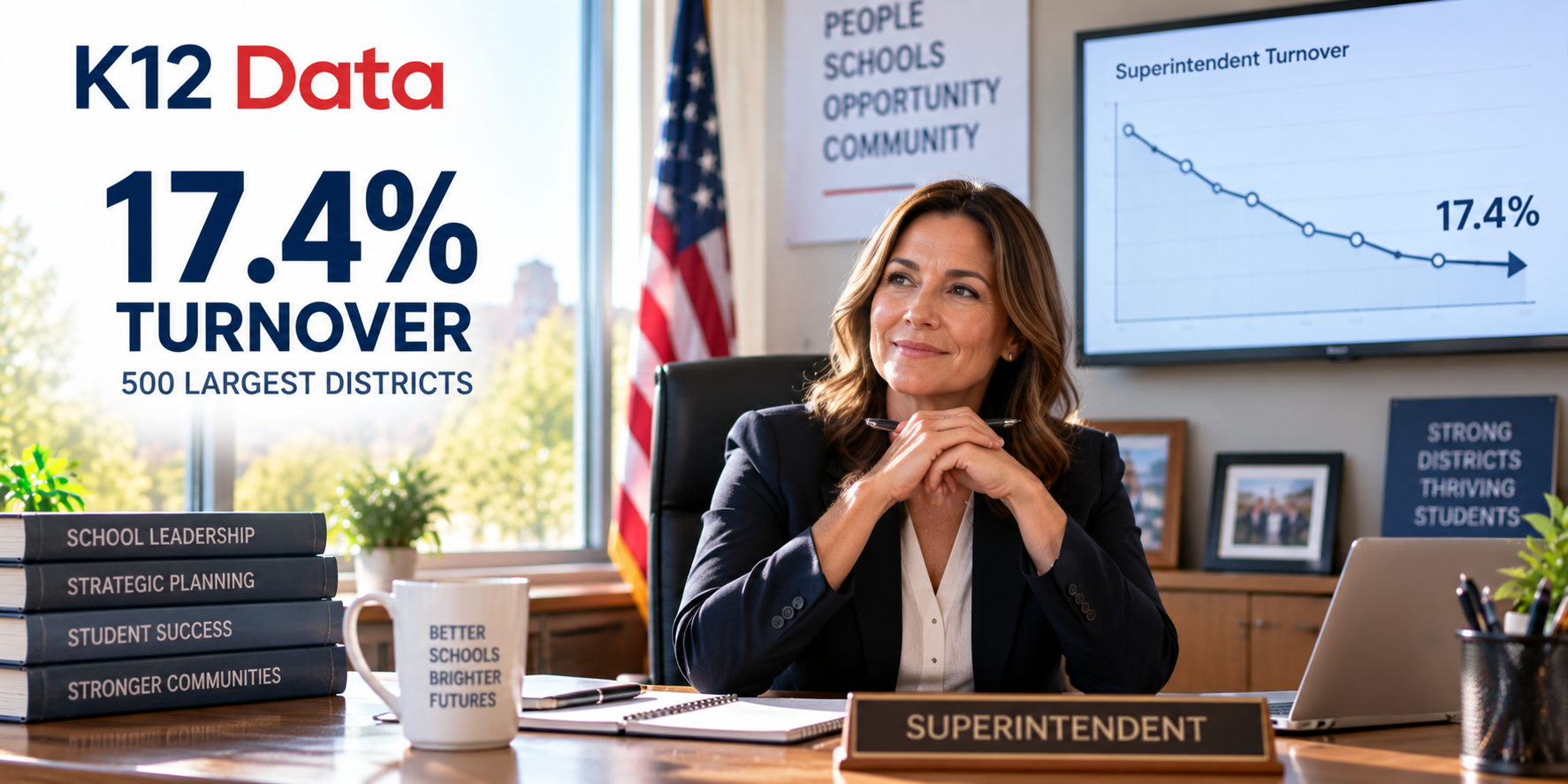
New ILO Group data shows superintendent turnover among the nation's largest districts fell to 17.4 percent this year, the lowest rate since before the pandemic, after peaking at 23 percent just two years ago.
Superintendent Turnover Just Fell to a Pandemic-Era Low, and It Changes How Districts Should Be Reached
Superintendent turnover among the nation's 500 largest school districts just fell to 17.4 percent, according to new data from ILO Group, the lowest rate since before the pandemic and a sharp drop from the 23 percent peak recorded just two years ago. For anyone building relationships with district leadership, whether that means marketing, advocacy, or direct outreach, this shift matters considerably more than a single statistic buried in a workforce report.
Eighty-seven of the nation's 500 largest districts saw their superintendent leave this year. That is still a meaningful number of transitions, but it represents a genuine return to the churn levels districts saw before 2020, when the pandemic, political pressure over curriculum and masking policies, and widespread burnout pushed superintendent turnover to levels the sector had never experienced at this scale.
Why the Drop to 17.4 Percent Is a Genuine Signal, Not Noise
A single year's turnover figure can be misleading if it reflects a temporary lull rather than a real trend. What makes this data meaningful is the trajectory: turnover climbed steadily from pre-pandemic norms to a 23 percent peak in the 2024-25 school year, and has now fallen back to levels last seen before 2020. That is not a plateau. It is a genuine reversal, and it suggests the acute instability that defined district leadership for the past several years is genuinely easing.
For district communications teams, edtech vendors, and organizations that market to superintendents directly, this reversal changes the calculus around outreach timing. A superintendent who just started an eighteen-month stint is a fundamentally different contact than one settling into year three or four of a stable tenure. Longer average tenures mean the relationships built with a district's top leadership today are considerably more likely to still be relevant a year from now.
What Drove the Spike, and Why It Is Reversing
The 23 percent peak two years ago reflected a genuinely unusual confluence of pressures: pandemic-era operational strain, intense political scrutiny over curriculum and health policy, school board conflict that made the superintendent's chair considerably less stable, and a wave of veteran leaders choosing early retirement rather than navigating an increasingly contentious role. Many of those pressures have not disappeared entirely, but the most acute version of that period has clearly passed.
Districts that weathered a leadership change during the peak years have generally had time to stabilize under new leadership, and fewer districts are entering a fresh crisis this year compared to the two years prior. That combination, fewer new crises plus prior transitions settling in, is likely the primary driver behind the drop back to pre-pandemic norms.
What This Means for Anyone Marketing to District Leadership
Outdated contact data has always been a problem in K-12 marketing, but it becomes a considerably bigger problem during periods of high turnover, when a superintendent contact purchased six months ago may already be obsolete. A return to pre-pandemic turnover rates does not eliminate that risk entirely, but it meaningfully reduces it, and it means the value of accurate, currently verified superintendent contact data extends further before it needs refreshing.
This is also a genuinely good moment for organizations that have been hesitant to invest in district-level outreach because of the instability of the past few years. A superintendent settling into a longer tenure is more likely to be building multi-year initiatives, evaluating vendor relationships for the long term, and making decisions that will actually stick, rather than simply managing a district through a transition period.
Why Central Office Contacts Matter Just as Much Right Now
Superintendent turnover does not happen in isolation. When a superintendent leaves, it frequently triggers turnover across the central office as new leadership brings in their own preferred deputies, curriculum directors, and communications staff. A lower superintendent turnover rate suggests a corresponding stabilization across central office roles more broadly, meaning the full slate of district decision-makers, not just the superintendent's own contact information, is likely more current and more durable than it has been in several years.
Organizations building outreach lists should treat this as a signal to invest in comprehensive central office coverage now, capturing not just the superintendent but the full leadership team around them, since that team is more likely than it has been in years to remain intact long enough to make sustained outreach worthwhile.
How This Compares to Turnover in Other Sectors
K-12 superintendent turnover has historically run higher than comparable executive roles in other public-sector institutions, a gap that widened considerably during the pandemic years. The return to a 17.4 percent rate brings superintendent turnover back in line with typical big-city government department head turnover, suggesting the sector is not just recovering from an unusual crisis but genuinely stabilizing at a rate consistent with comparable executive roles elsewhere in the public sector.
This context matters for anyone benchmarking district leadership stability against other institutions they also market to or partner with. A superintendent's tenure risk is no longer meaningfully higher than a city manager's or a state agency director's, which should reshape how organizations that work across multiple public-sector verticals think about relative outreach investment and timing.
A Concrete Scenario Worth Walking Through
Consider a district-facing marketing director who has spent the past two years watching carefully built superintendent contact lists go stale within months, forcing constant re-verification and undermining any multi-touch outreach campaign that depended on a stable point of contact. This same director, now working against a backdrop of turnover at its lowest level since before the pandemic, has genuine reason to invest in a longer-horizon outreach strategy, one built around relationship depth rather than constant list refreshing alone.
This scenario illustrates why the shift matters beyond the statistic itself. Districts with stable leadership are more receptive to sustained outreach and more likely to engage with a vendor or advocacy organization over multiple touchpoints, rather than the single rushed interaction that often characterizes outreach to a superintendent who is already halfway out the door. That kind of sustained relationship building was considerably harder to justify during the peak turnover years, when the odds of a contact staying in place long enough to see a multi-touch campaign through to completion were meaningfully lower.
What a More Stable Leadership Cycle Means for Long-Term Advocacy
Organizations engaged in state or federal education advocacy, not just direct marketing, benefit considerably from a more stable superintendent corps as well. Coalition-building around funding formulas, staffing policy, or curriculum standards depends heavily on maintaining relationships with the same leaders over multiple legislative sessions. A revolving door of new superintendents forces advocacy organizations to constantly rebuild relationships from scratch, losing momentum on multi-year policy initiatives every time a key ally leaves the role before a bill or funding cycle completes.
With turnover back near pre-pandemic norms, advocacy groups working state legislative sessions or federal appropriations cycles have a genuinely better chance of carrying institutional relationships through to an actual policy outcome, rather than starting over with a new superintendent just as a multi-year initiative was gaining traction.
What Districts Still Experiencing Turnover Signal for Marketers
The 87 districts that did see a superintendent departure this year are not evenly distributed, and districts navigating an active transition right now represent a genuinely different opportunity than those with stable leadership. A newly appointed superintendent is often actively reevaluating vendor relationships, curriculum choices, and communications strategy during their first year, creating a distinct window for organizations positioned to reach that specific leader early in their tenure with accurate, up-to-date contact information.
Marketers should treat these two groups, the newly stabilized majority and the actively transitioning minority, as requiring genuinely different outreach strategies rather than a single undifferentiated approach to the superintendent role as a whole. A first-year superintendent still forming vendor relationships and a fourth-year superintendent with an established set of trusted partners respond to fundamentally different messaging, and treating both groups identically wastes the genuine advantage this data now makes visible.
The practical takeaway for anyone building a district outreach strategy this year is straightforward: segment contact lists by tenure where that data is available, prioritize deeper, relationship-based outreach for the stabilized majority, and reserve faster, more transactional outreach for districts in active transition, where a new superintendent is still making first-year decisions and has not yet settled into established vendor relationships.
Frequently Asked Questions
What is the current national superintendent turnover rate?
Superintendent turnover among the nation's 500 largest school districts fell to 17.4 percent this year, according to ILO Group, the lowest rate since before the pandemic.
How does this compare to the pandemic-era peak?
Turnover peaked at 23 percent during the 2024-25 school year. The current 17.4 percent rate represents a genuine return to pre-pandemic norms rather than a temporary dip.
Why does superintendent turnover matter for K-12 marketing and outreach?
Lower turnover means longer average tenures, which makes superintendent and central office contact data remain accurate and relevant for longer, and makes district leaders more receptive to sustained, multi-touch outreach.
Superintendent turnover falling to its lowest level since before the pandemic is genuine, measurable progress for district stability, and it changes the underlying math for anyone whose outreach depends on reaching the right decision-maker at the right time. Organizations building durable relationships with district leadership, rather than treating every superintendent contact as a short-term target, are positioned to benefit considerably more from this period of relative stability than those still operating as though every contact will be gone within the year.
This same pattern of institutions settling into more stable footing is showing up elsewhere in education and workforce data this year. Higher education is seeing a related integrity push too, since colleges nationwide confronting a surge in AI-enabled ghost student fraud reflects institutions working to protect the legitimacy of their own enrollment numbers. K-12 staffing is facing a related stability question too, since a governor's push to ban H-1B visas for teachers shows districts actively rethinking where their teacher pipeline comes from.
Ready to reach the superintendents and central office leaders now settling into longer tenures? Build a verified K-12 database, or buy a superintendent email list, with K12 Data today.