
 0
0

There are 0 items in your cart: Cart Subtotal: $ 0.00
The Back-to-School Email Window Is the Highest-ROI Campaign in K-12 -- If You Know Which Week Actually Converts

 The K12 Marketplace
  1
1
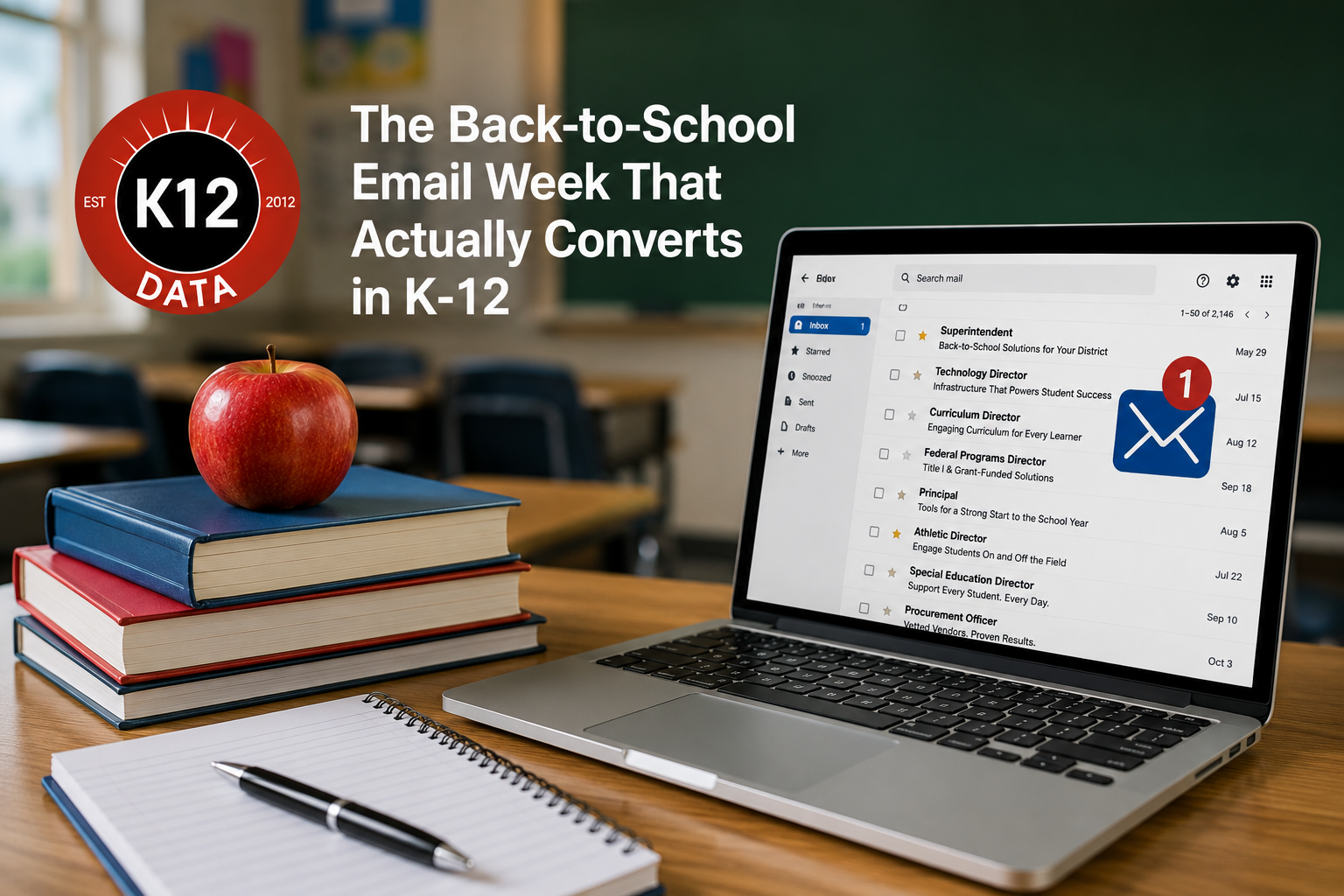
Most K-12 vendors run back-to-school email campaigns. Almost none have mapped which specific week converts by contact tier. The answer is not July. It is different for superintendents than for technology directors than for Federal Programs Directors.
The Back-to-School Email Window Is the Highest-ROI Campaign in K-12 -- If You Know Which Week Actually Converts
Every K-12 vendor runs a back-to-school email campaign. The question that almost nobody has rigorously answered is which specific week within that window actually produces the highest open rates, the highest click-through, and the most pipeline-convertible conversations. Most vendors guess -- they launch in July because July feels like back-to-school, or they push hard the week before the first day of school because urgency feels right. Almost none of them have mapped the actual engagement data by contact tier, by decision-making role, and by product category.
The data, when you look at it carefully, tells a more specific and more actionable story than the generic "summer is the time to reach districts" conventional wisdom suggests. The highest-converting week for an email to a superintendent is different from the highest-converting week for an email to a technology director, which is different again from the highest-converting week for an email to a Federal Programs Director. The product category matters too -- a curriculum platform email and a school safety technology email and a professional development platform email have different peak engagement windows because they are relevant to different planning processes on different timelines. Getting this timing right is not a minor optimization. It is the difference between an email campaign that generates meaningful pipeline and one that produces solid open rates and almost no response.
Why July Is the Wrong Answer for Most Campaigns
The intuition behind July back-to-school campaigns is understandable. Administrators are not yet consumed by the chaos of the school year. There is theoretically time to think about new programs and new vendor relationships. The back-to-school framing feels relevant. The problem is that this intuition describes the conditions for administrator attention, not the conditions for administrator purchasing readiness.
A superintendent or curriculum director in July who is not yet consumed by the school year is not consumed by the school year because their decisions are already made. The major system purchases, the curriculum adoptions, the professional development contracts that will launch with the school year have been decided and contracted in the spring. A vendor arriving in July with a pitch for a new platform launching in September is arriving after the decision that would have been the most valuable conversation has already happened somewhere else.
The vendors getting the highest ROI from back-to-school email campaigns are not the ones sending the most polished emails in July. They are the ones who have mapped the actual decision-making timeline for each product category and each contact tier and built their campaign calendar around it rather than around the generic "summer is the time" assumption.
The Real Email Conversion Calendar by Contact Tier
Superintendents and Assistant Superintendents: Late May and Early June
The highest-value superintendent email engagement happens before most vendors think the season starts. Superintendents are making or finalizing major vendor decisions in their spring board cycle -- April, May, and into June. An email campaign that reaches superintendents in late May and early June, when they are in active decision mode for the following school year, is arriving at a moment of genuine receptivity. The superintendent checking email in July is likely in transition mode -- wrapping up the current year, beginning to prepare for the new one -- but the purchasing decisions that require superintendent-level sign-off have mostly been made or are nearly finalized. The vendors winning superintendent-level email engagement are running it in May and June, not July.
Technology Directors and IT Leadership: July Is Actually Correct
Technology directors are the contact tier for whom July back-to-school outreach is genuinely well-timed. Technology implementation work -- device rollouts, infrastructure upgrades, system configurations -- happens over the summer precisely because school is not in session and the disruption risk is lower. A technology director in July is often actively managing implementation projects and evaluating the next phase of technology decisions while the operational pressure of a running school is absent. The back-to-school email window for technology directors runs from late June through late July, with the highest engagement typically in the first two weeks of July when implementation projects are fully underway and next-cycle planning is beginning simultaneously.
Curriculum Directors: August, After the Calendar Is Set
Curriculum directors who are evaluating supplemental materials, intervention programs, and curriculum additions -- as opposed to full adoption cycles, which happen in the spring -- are often making those supplemental decisions in August, once the master schedule is set and the specific gaps in the instructional calendar are visible. A curriculum-focused email campaign in August, specifically addressing the supplemental and intervention categories that get decided after the main schedule is built, is reaching a decision-maker at the moment when the specific need being addressed is in focus. August is a weak month for major platform decisions but a strong month for supplemental and intervention purchasing conversations.
Federal Programs Directors: September and October
As documented in earlier research in this content series, Federal Programs Directors operate on the federal fiscal year -- October through September -- which means their highest purchasing engagement is entirely outside the summer window that most back-to-school campaigns target. The highest-converting email window for Federal Programs Directors is September and October, when the new federal fiscal year begins and compliance planning for Title I, Title II, and IDEA spending is actively underway. A vendor who builds a separate September-October sequence specifically for Federal Programs contacts, entirely distinct from the general summer back-to-school campaign, is accessing a purchasing window that the summer campaign cannot reach.
This timing intelligence connects directly to the email marketing approach documented across this content series for other education verticals. College Data's research on higher education email deliverability documents the same principle applied to the higher education calendar -- enrollment planning cycles, FAFSA processing windows, and budget authority timing all create distinct email engagement peaks that generic campaign calendars miss. And the government purchasing calendar documented in Civic Data's research on email marketing timing for government officials follows the same logic: grant application windows, budget adoption cycles, and post-election transition periods create predictable engagement peaks that vendors who know them are hitting reliably while vendors who do not know them are missing consistently.
What High-Converting K-12 Email Looks Like
Subject Lines That Work by Role
Superintendent subject lines that convert reference board-level outcomes and financial accountability: specific numbers, specific results, specific risk reduction. Technology director subject lines that convert reference implementation efficiency and integration with existing systems. Curriculum director subject lines that convert reference student outcome data -- specific gains in specific populations. Federal Programs Director subject lines that convert reference allowable-use categories and compliance support. A subject line that works brilliantly for a technology director -- "How districts like yours cut device rollout time by 40 percent" -- will perform mediocrely with a superintendent who is not managing device rollouts personally. Role-specific subject lines are not a minor personalization refinement. They are a fundamental campaign architecture decision.
Send Time Within the Day
The optimal send time for K-12 administrator email is narrower than most campaigns treat it. The highest open rates for superintendent and curriculum director email consistently cluster in a window from 6:30 AM to 8:00 AM local time -- before the school day begins, when administrators are reading email before their schedule fills. A campaign sent at 10:00 AM is competing with a school day already underway. Technology directors, who are more likely to have genuine desk time during the school day, show a broader optimal window extending through mid-morning. The thirty-minute precision that email platform data can provide on optimal send time is genuinely worth using.
Follow-Up Cadence
The highest-converting back-to-school email sequences use a compressed follow-up cadence calibrated to the urgency of the season: an initial send, a follow-up three to four days later if no engagement, and a final value-add send one week after the follow-up. Longer gaps lose the back-to-school urgency that makes the window valuable in the first place. Shorter gaps for a contact who has not opened feel aggressive in a professional context where the recipient has genuine authority and genuine alternatives. The three-to-four-day gap is the sweet spot -- persistent without being pushy, sustained without losing momentum.
The List Quality Underneath Every Campaign
Timing strategy and subject line optimization only produce meaningful ROI on top of a school district email list that is accurate, current, and segmented to the level of specificity that role-targeted campaigns require. A perfectly timed, perfectly written email to a contact who left the district eighteen months ago, or to a superintendent whose title has changed to assistant superintendent, or to a technology director whose district has already selected a different vendor for the category being pitched, produces zero ROI regardless of how good the subject line is.
The data foundation is not a campaign tactic. It is the prerequisite that determines whether campaign tactics are worth executing. A school mailing list that is updated continuously, segmented by role and decision-making authority, and built around the full contact hierarchy of a district -- not just the superintendent, but the technology director, the curriculum director, and the Federal Programs Director -- is the asset that all the timing intelligence and subject line strategy in the world is built on top of.
- Segment your email list by contact tier before building your campaign calendar -- different roles have different peak engagement windows and require different subject line approaches.
- Build a separate September-October sequence for Federal Programs Directors that runs entirely outside your back-to-school campaign infrastructure.
- Test send times with role-level granularity -- the optimal time for superintendent email and the optimal time for technology director email are genuinely different.
- Use the three-to-four-day follow-up gap for back-to-school sequences to maintain urgency without crossing into aggressive territory for a professional audience with real authority.
The ROI of email marketing into K-12 is directly correlated with the quality and segmentation of the underlying school district contact database. This is the same principle documented in College Data's research on higher education email deliverability and in Physician Data's research on healthcare email performance -- in every sector, the list quality underneath the campaign determines what the campaign can possibly achieve. Reach the right K-12 contacts at the right time through k12-data.com/build-a-list.
Conclusion
The back-to-school email window is genuinely the highest-ROI campaign opportunity for K-12 vendors -- but only when it is mapped to the actual decision-making calendar of the specific contact tier being targeted rather than to the generic summer narrative that produces activity without pipeline. The vendors running role-specific timing, role-specific subject lines, and a compressed follow-up cadence on top of a current, segmented school mailing list are generating the pipeline that the vendors running generic July campaigns are reporting as unusually low this season. The gap between the two is not content quality or creative execution. It is data and timing discipline applied at a level of specificity that most campaigns never reach.
K12 Data -- Build a List | Pricing | Blog College Data -- Build a List | Pricing | Blog Physician Data -- Build a List | Blog Civic Data -- Build a List | Blog K12 Talent -- Post a Job | Search Jobs | Blog