
 0

There are 0 items in your cart: Cart Subtotal: $ 0.00
About One in Five Young People Has Asked an AI Chatbot for Mental Health Advice, and Districts Can Respond by Making Sure Every Student Has a Trusted Adult

 The K12 Marketplace
 0
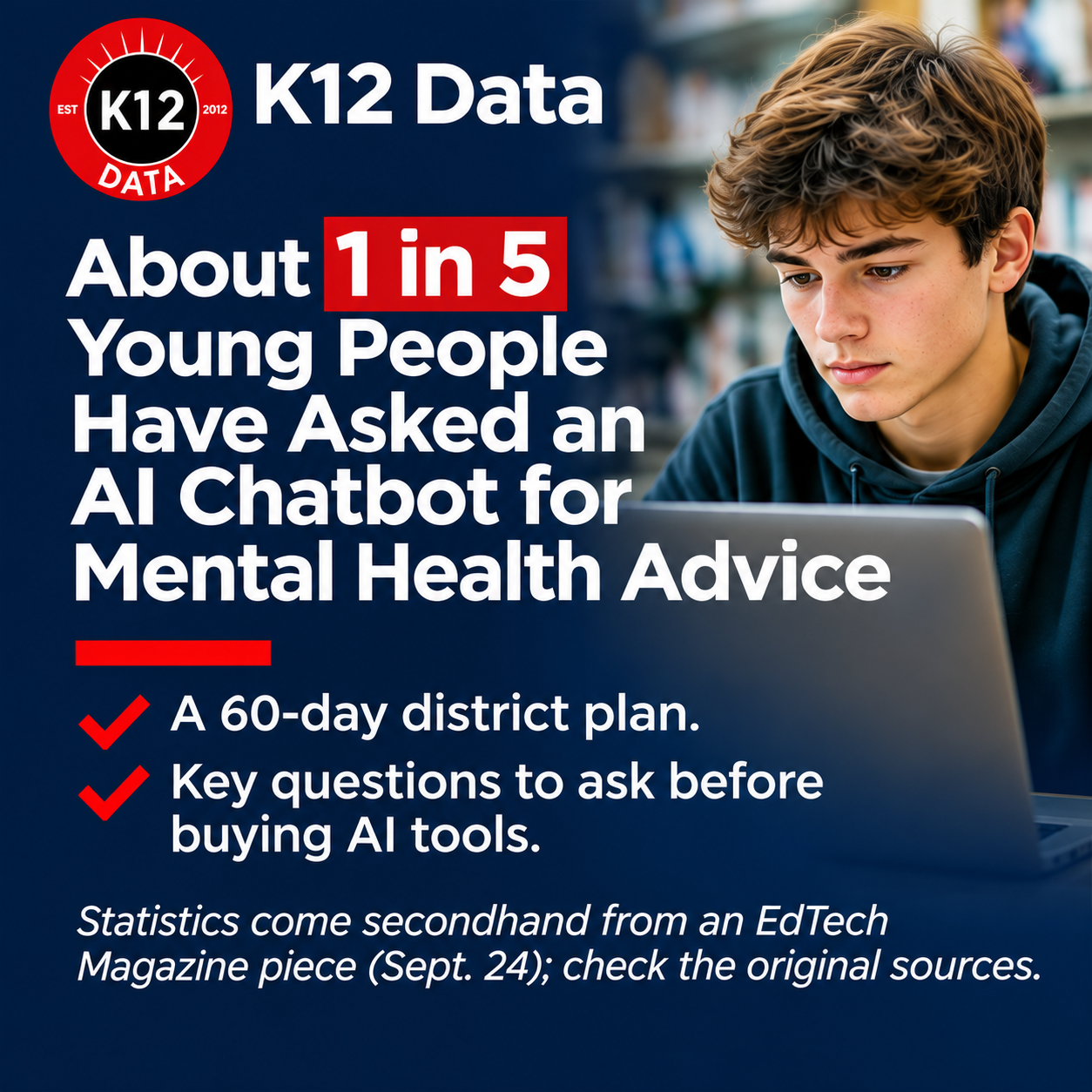
About one in five young people has used an AI chatbot for mental health advice. See what the data says, the caveats, a district plan, and why trusted adults and peers still matter most.
About One in Five Young People Has Asked an AI Chatbot for Mental Health Advice, and Districts Can Respond by Making Sure Every Student Has a Trusted Adult
Students are turning to AI at midnight for problems that deserve a human being. Districts do not have to choose between banning the tools and ignoring the issue.
Key Takeaways
- EdTech Magazine reported on September 24 that a 2026 JAMA Pediatrics survey found about 1 in 5 U.S. young people ages 12 to 21 used an AI chatbot for mental health advice, and nearly two-thirds told no one, though the article cites these figures secondhand.
- Common Sense Media found 72 percent of teens had tried an AI companion and about one-third used one for social interaction or relationships, and a 2026 Pew parent survey found only 51 percent of parents said their teen used chatbots while 64 percent of teens did.
- The American Psychological Association advises against using generative AI chatbots as a replacement for mental health treatment, and educators quoted in the article urged guidance and trusted adults, not bans alone.
- The evidence base is early: the statistics are secondhand, the article is a practitioner piece, and New York City's one-year pause on student-facing AI shows that large districts are still debating the right response.
The Conversation Students Are Not Having With Us
Ask a school leader about student AI use and the answer is usually about homework. A September 24 article in EdTech Magazine by teacher and consultant Rachelle Dené Poth points to a quieter pattern. According to a 2026 JAMA Pediatrics survey that the article cites, about 1 in 5 U.S. young people ages 12 to 21 has used an AI chatbot for mental health advice, and nearly two-thirds of them told no one.
Other figures in the piece point the same way. Common Sense Media found that 72 percent of teens had tried an AI companion and that about one-third used them for social interaction or relationships. A 2026 Pew Research Center parent survey found 64 percent of teens reported using chatbots, but only 51 percent of parents said their teen did, and about 3 in 10 parents were unsure. Every one of these numbers is secondhand in the article, with no sample sizes or question wording, so districts should check the original sources before quoting them. The direction is hard to ignore, though: adults often do not know.
A chatbot is always awake. That is its appeal, and it is exactly why a student needs a person who is awake too.
Why Students Turn to a Screen
The article offers plain reasons. Chatbots are available at any hour, cost little, answer immediately, and seem nonjudgmental, especially for a student who fears embarrassment or stigma. Kristen Mattson, a University of Illinois lecturer quoted in the piece, said that just saying no “glosses over the root issues causing young people to turn to AI in the first place.” Those root issues are often loneliness, fear of being judged, and not knowing whom to ask.
That reading matters for policy. A ban addresses the tool. It does nothing about the need underneath it. Jessica Gillespie of Griswold Public Schools in Connecticut said students “want guidance around AI, not just to be told not to use it.”
What the Experts Worry About
The author lists several concerns, and she is careful to say they are stated generally, not proven by specific studies in the article. Chatbots may miss warning signs, reinforce harmful thoughts, or give inappropriate advice, and they lack the clinical judgment to recognize when a student needs human help. Students may share sensitive details that a product retains or reuses. Bias may make tools less safe for students whose language, culture, identity, or disability is poorly represented. The American Psychological Association advises against using generative AI chatbots as a replacement for mental health treatment.
Buddy Berry, superintendent of Eminence Independent Schools in Kentucky, put the principle simply: AI “can never replace the meaningful relationships and trusted adults” that support student well-being.
Districts Are Still Searching for the Right Response
There is no consensus yet. In September, K-12 Dive's Anna Merod reported that New York City will pause student-facing AI tools for a year for students from 2-K through eighth grade, about 600,000 students, while teachers may still use AI for planning and operations. Mayor Zohran Mamdani said, “The tech industry wants us to believe that A.I.-powered early education is not only inevitable, but necessary.” Others disagreed with the approach. Jean-Claude Brizard, CEO of Digital Promise, said banning AI is not the answer and that schools should train adults to guide student use.
Districts do not need to take a side in that debate to act. Whatever a district decides about tools, every student benefits from guidance, trusted adults, and a clear path to help.
A Voice From the Field: Tom Murphy and Sweethearts & Heroes
One of the people who has thought longest about this is Tom Murphy, the founder of Sweethearts & Heroes. Murphy is a former All-American wrestler and UFC competitor who moved from a corporate career to full-time youth advocacy, and he has spent years in schools. Sweethearts & Heroes, which he founded in 2006 with Rick Yarosh as co-founder, builds its work around the message of H.O.P.E., which stands for Hold On, Possibilities Exist, and around action. Its stated focus, per its About page, is to “educate society on the impact of hopelessness, build empathy and compassion in our youth.”
The organization's programs include school assemblies, a student circle model, and youth leadership programs that train students to look out for one another. Its site describes a goal of developing young people who step in as bystanders and leaders. On the organization's home page, Murphy says, “We are training a generation of young people before whom the world will marvel.” Whatever one thinks of any program, the idea behind it is worth borrowing: students are most likely to be helped by someone who notices them, and a school full of students trained to notice each other has far more eyes than any counseling office.
Districts considering any outside program should ask for evidence, references, and alignment with their own standards. You can learn more about Murphy's background on his profile page.
The best technology policy a school can have is a student who knows exactly which adult to find.
A Starter Plan for the Next 60 Days
Districts can respond without waiting for a perfect policy. In the first two weeks, ask counselors, school psychologists, and principals what they are hearing about student AI use for emotional support, and review what your current acceptable-use policy says. In weeks three and four, draft short guidance for students and staff that explains the risks in plain language and names the humans students can go to. In weeks five and six, review any AI wellness product already in use, including privacy terms, data retention, and escalation to a human. In weeks seven and eight, train staff to recognize the signs and to respond with curiosity, not punishment, and brief the board.
Consent and privacy deserve attention, too. Our earlier look at federal agencies' position on written parental consent for student mental health screenings shows how closely regulators watch this area.
Questions to Ask Before Buying an AI Tool
Before a district buys any student-facing AI product, several questions help. What data does it collect, how long is it kept, and who can see it? What happens when a student describes a crisis, and how quickly does a human get involved? What evidence exists that it helps learning or well-being, and who produced that evidence? How does it perform for multilingual learners and students with disabilities? Can the district turn off features it does not want? A vendor that answers plainly deserves a longer look.
Build Connection Where Students Already Are
The most durable response is to make human connection easier than a chat window. That can mean advisory periods with real conversation, mentor programs for students who have missed school, clubs and teams that give students a reason to belong, and peer programs that train students to support one another. It can also mean simple routines: greeting students at the door, noticing who sits alone, and making sure each student has at least one adult who knows their name and story.
This connects to what districts are learning about attendance. In recent reports, principals ranked school connectedness first among strategies that work against chronic absenteeism. The same relationships that bring students to school are the ones that give them somewhere to turn when something is wrong.
Use AI Where It Gives Teachers Time Back
None of this means AI has no role. A Walton Family Foundation and Gallup survey of more than 1,900 educators, reported by K-12 Dive on October 16, found nearly three in five educators used AI for work in 2025-26, and nearly two-thirds of those users said it freed time for parts of the job they value most, such as interacting with students. The time savings were self-reported, and the article does not show that the time was actually used for more student interaction. Still, it points toward a sensible principle: AI that handles paperwork so teachers can spend more time with kids is different from AI that replaces the conversation. See our look at how districts can turn saved time into student time.
Who Needs to Be Involved
This work crosses desks. The superintendent sets the tone and the policy. School principals shape daily culture. The director of student services, school counselors, and school psychologists lead support. The chief technology officer reviews tools and data practices. The director of curriculum and instruction connects AI literacy to teaching. School board members approve policy and answer to families. For a closer look at who holds which job, see the 25 K-12 decision-maker job titles every education marketer should know.
Questions Boards Will Ask
Board members who read about student AI use will ask sensible questions. What are we hearing from our own students? What does our policy say, and is it understood? Which tools in our schools touch student well-being, and who reviewed them? How many students can name a trusted adult? What are we doing to build connection? A superintendent who can answer shows the board that the district is managing a new issue on purpose.
Signals to Watch
Several developments are worth following: the original JAMA Pediatrics and Pew data behind the secondhand statistics, results from New York City's year-long pause, any federal or state guidance on student-facing AI, new research on AI and adolescent development, and whether districts report changes in help-seeking as connection programs grow. Each will show how schools balance innovation with the human relationships students need.
If you want to reach the people who lead this work, K12 Data can help. Our school district email lists and K-12 database give you education contact data for every role in this story: a superintendent email list, a school principal email list, a director of student services email list, a school counselor email list, a school psychologist email list, a chief technology officer email list, a director of curriculum and instruction email list, and a school board member email list. If you are ready to buy school email list data, or want a K-12 marketing database filtered by role, state, and district size, build a targeted list here while districts are writing their AI and student well-being guidance.
Frequently Asked Questions
Are students using AI chatbots for emotional support?
Many appear to be. A 2026 JAMA Pediatrics survey, cited by EdTech Magazine, found about 1 in 5 U.S. young people ages 12 to 21 used an AI chatbot for mental health advice, and nearly two-thirds told no one. The figures are secondhand, so check the original source.
What should districts ask before buying AI tools?
Ask what data is collected and retained, what happens when a student describes a crisis, what evidence supports the tool, how it works for multilingual learners and students with disabilities, and whether the district can turn features off.
What is Sweethearts & Heroes?
Sweethearts & Heroes is an organization founded in 2006 by Tom Murphy, with Rick Yarosh as co-founder, that brings the message of H.O.P.E. (Hold On, Possibilities Exist) to students and educators through assemblies, leadership programs, boo