
 0

There are 0 items in your cart: Cart Subtotal: $ 0.00
Nearly 3 in 5 Educators Used AI for Work Last Year, and Districts That Add Guidance Can Turn Saved Time Into Student Time

 The K12 Marketplace
 0
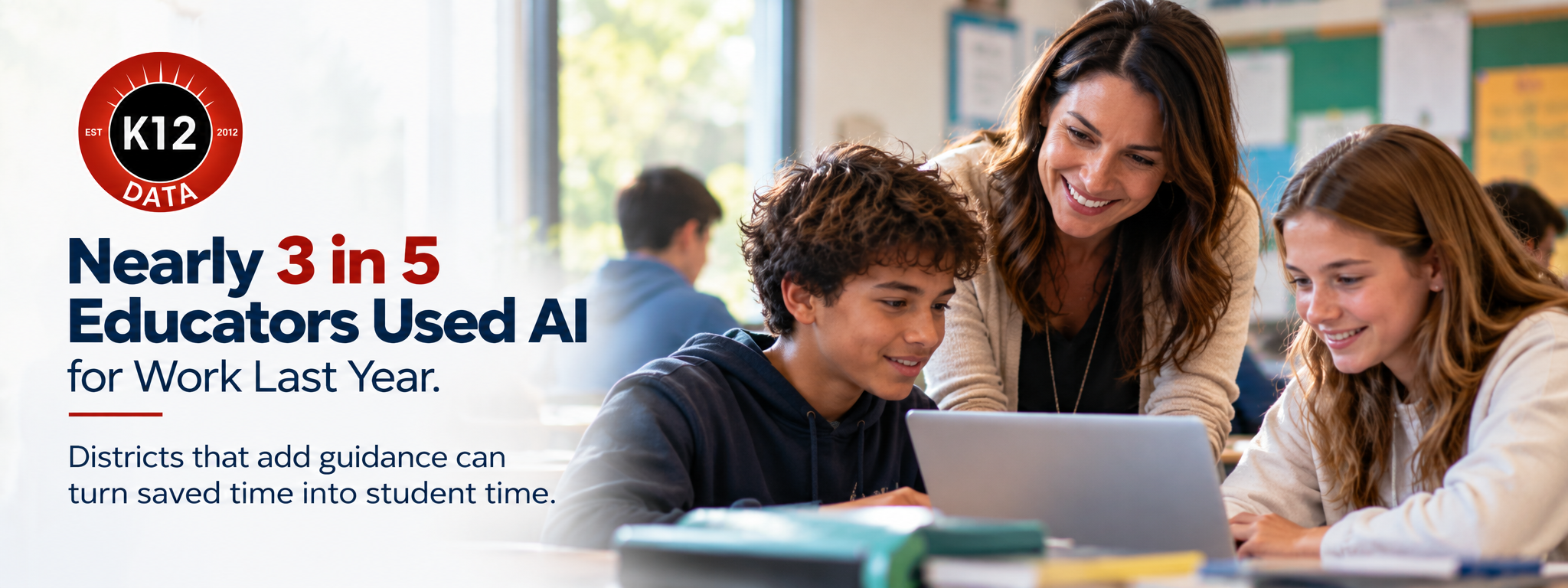
A Walton Family Foundation and Gallup survey finds nearly 3 in 5 educators use AI and many say it frees time for students. Here is what it means and how districts can add guidance.
Nearly 3 in 5 Educators Used AI for Work Last Year, and Districts That Add Guidance Can Turn Saved Time Into Student Time
A new Walton Family Foundation and Gallup survey of more than 1,900 educators finds that AI users say the tools give them time back for the parts of teaching they value most. The next step for districts is shared guidance.
Key Takeaways
• The Walton Family Foundation and Gallup surveyed more than 1,900 educators from late July to mid-August 2026 and released results October 14. Nearly 3 in 5 said they used AI tools for work in the 2025-26 school year.
• Nearly two-thirds of AI users said the tools freed up time for the parts of the job they care about most, such as interacting with students.
• Use was highest among educators ages 40 to 49, at 67 percent, and lowest among those 60 and older, at 46 percent.
• An earlier Gallup and Walton survey found that more than 60 percent of teachers had received no guidance on some uses of AI, which gives districts a clear and affordable place to act.
What the Survey Found
Conversations about artificial intelligence in schools tend to swing between alarm and hype, so a large survey of working educators is a useful reality check. On October 14, the Walton Family Foundation and Gallup released findings from a survey of more than 1,900 educators, with responses collected from the end of July to the middle of August 2026. K-12 Dive reporter Naaz Modan covered the results on October 16.
The headline number is adoption. Nearly 3 in 5 educators, about 60 percent, said they used AI tools for their work during the 2025-26 school year. They described using chatbots, adaptive learning systems, and other interactive platforms for creating learning and assignment materials, grading, providing feedback, and administrative work.
The second number is the one district leaders will want to repeat. Nearly two-thirds of AI users said the tools freed up time for the parts of their job they care about most, such as interacting with students. According to the article, 51 percent of those users said AI gave them “somewhat more time” for the parts of teaching that matter most to them.
The strongest case for AI in schools is not that it replaces teachers. It is that it can hand them back the hours they want to spend with students.
Where the Saved Time Goes
The survey also asked what educators value about the work. Teachers most valued helping students through difficult material, seeing students succeed academically, and giving individual feedback. Completing administrative or required paperwork ranked lowest. That pattern helps explain the reaction from AI users: the tasks these tools handle best, such as drafting materials and routine administration, sit at the bottom of teachers' wish lists, while the work they want more of sits at the top.
For district leaders, that suggests a better way to judge any AI program. Counting logins or licenses says little. A more useful question is what a teacher does with an hour back. Small-group instruction, one-on-one conferences, and detailed feedback on writing are all examples. Districts that ask this question in a short staff survey will learn quickly whether a tool is helping or just adding another login.
Who Is Using AI
Adoption was not limited to younger teachers. Use peaked among educators ages 40 to 49, at 67 percent, followed by those ages 50 to 59, at 63 percent. Educators under 40 were close to the overall average of about 60 percent, and those 60 and older reported the lowest use, at 46 percent, which still means nearly half of the oldest group had tried AI for work.
That has a practical consequence for professional development. Sessions designed only for new teachers will miss a large share of the people already using these tools. Mid-career and veteran teachers carry heavy loads of grading and material preparation, which is exactly where AI use is concentrated, and they often respond well to peer-led demonstrations from colleagues they trust.
The Guidance Gap Is the Opportunity
The most actionable finding comes from an earlier Gallup and Walton survey from May 2026, which K-12 Dive cited alongside the new results. Over 60 percent of teachers reported receiving no guidance on applying AI to parts of their jobs such as analyzing student learning patterns, tutoring, and one-on-one instruction. Nearly 60 percent lacked guidance on using AI for grading, feedback, or supplementing instruction. Just under 50 percent had no guidance on using AI to create assignments and class materials or to adapt materials for student needs.
It is worth reading that as good news. Teachers have found useful applications on their own, and the guidance that would make those uses safer and more consistent is inexpensive compared with new software. A district that publishes clear expectations, examples, and data rules can move quickly from scattered experimentation to shared practice.
Teachers are already using the tools. The open question is whether their districts will give them a shared set of rules and examples.
Reading the Numbers Carefully
As with any survey, context matters. The “freed up time” findings are self-reported by educators and do not establish measured time savings. The 51 percent figure applies only to educators who used AI, not to everyone surveyed. The article does not report a margin of error or a fuller methodology, and comparisons across surveys can be imprecise because their designs and sponsors differ.
With those cautions in mind, the picture is consistent with other research. K-12 Dive noted that an Instructure survey from July 2026 found 68 percent of educators use AI at least occasionally and 73 percent of parents say their children do, while a RAND Corporation survey from 2024 found only 18 percent of teachers reported using AI tools in their classrooms. The direction is clear even if the exact levels vary.
Teacher Tools and Student Tools Are Different Decisions
The policy backdrop is mixed, and it helps to separate two questions. In September, New York City announced what it called its most expansive AI moratorium for students, a one-year pause on student-facing AI tools from preschool through 8th grade during 2026-27, affecting about 600,000 students. K-12 Dive noted that no similar restrictions have been announced for teachers. We covered that decision in our look at New York City's pause on student-facing AI, and the rollout questions in our analysis of Frederick County's student AI ban.
The lesson for districts is that caution about what students use and support for what teachers use can go together. A district can take its time on student-facing tools while giving teachers clear, practical guidance for the administrative and planning work where the time savings are reported.
A Five-Step Guidance Checklist
A district does not need a long policy to get started. First, name the approved teacher-facing uses, such as drafting materials, generating practice questions, and summarizing routine communications, and name the uses that need review, such as grading decisions that affect a student's record. Second, set data rules: no student names or personal information in tools without a signed agreement.
Third, make clear that the teacher stays responsible for anything sent to students or families. Fourth, build a small library of examples by grade band and subject so a new user can see what good use looks like. Fifth, create a feedback channel and a review date, so the guidance improves as tools and experience change.
Professional Development That Sticks
Short, practical sessions work better than a single large training. Teacher-led demonstrations, protected time to practice with a real lesson or assignment, and a follow-up conversation a few weeks later help new habits take hold. A brief pulse survey, asking what teachers tried, what saved time, and what caused trouble, gives leaders the evidence they need to adjust.
Districts that connect this work to existing priorities tend to see better results. If a school is focused on feedback quality, AI-assisted drafting can support it. If the goal is more small-group instruction, planning tools can free the time. Tying the tool to a goal keeps the conversation about students, not technology.
Talking With Families and Boards
Communication builds trust. A one-page summary that explains what teachers use AI for, what they do not use it for, and how student information is protected answers most of the questions families ask. Sharing the same page with the school board before it goes home avoids surprises.
The most useful message is simple: teachers are using new tools to spend more time with students, and the district has rules in place. Districts that say this plainly, and invite questions, tend to find that families respond with interest rather than alarm.
Who Decides AI Tools in a District
AI decisions cross several desks. The chief technology officer and instructional technology director evaluate platforms and manage data security. The director of curriculum and chief academic officer decide how tools fit instruction. A professional development director plans training, and an assistant superintendent for teaching and learning often connects the pieces. The superintendent sets direction, and principals shape what happens in each building.
Our guide to the 25 K-12 decision-maker job titles shows how those roles typically divide the work. For anyone who serves this audience, the lesson is that a good outreach plan reaches both the leader who approves a program and the person who runs it.
What Vendors Should Take From This
For education technology companies, the survey carries a clear message. Teachers respond to tools that give time back, so lead with the hours saved and show how. Provide guidance materials, sample prompts, and data documentation alongside the product, since more than half of teachers say they have not been told how to use AI for many tasks. Districts will favor partners who make the guidance easy.
Evidence matters too. Self-reported savings are a good start, but vendors who can help a district measure what changed, such as time spent on feedback or the number of small-group sessions, will stand out when renewal season arrives. Careful buyers tend to be loyal buyers.
Questions Superintendents and Boards Will Ask
As adoption grows, board meetings are likely to bring a familiar set of questions. Which AI tools are teachers using, and who approved them? What student information do those tools collect? What training have staff received? How will we know whether the tools are helping students? Having short, clear answers ready builds confidence long before a concern turns into a controversy.
District leaders can also borrow a habit from strong budget offices: write the answers down once and update them each semester. A living one-page summary keeps principals, teachers, and families working from the same facts, and it makes new tools easier to evaluate because the standards are already in place.
Signals to Watch
Several developments are worth following: whether future surveys measure time savings directly instead of relying on self-reports, how many districts publish teacher-facing AI guidance this year, how states respond with their own frameworks, and how student-facing policies evolve in places like New York City. Each will show how quickly guidance catches up with use.
If you want to reach the leaders who will write that guidance, K12 Data can help. Our school district email lists and K-12 database give you education contact data for every role in this story: a chief technology officer email list, a director of curriculum email list, an instructional technology director email list, a chief academic officer email list, a professional development director email list, an assistant superintendent email list, a superintendent email list, and a school principal email list. If you are ready to buy school email list data, or want a K-12 marketing database filtered by role, state, and district size, build a targeted list here while districts are building their AI guidance.
Frequently Asked Questions
How many teachers use AI at work?
A Walton Family Foundation and Gallup survey of more than 1,900 educators, released October 14, 2026, found that nearly 3 in 5 educators, about 60 percent, used AI tools for work in the 2025-26 school year. Use was highest among ages 40 to 49, at 67 percent.
Do teachers save time with AI?
Many AI users say so. Nearly two-thirds said AI freed up time for the parts of their job they care about most, such as interacting with students. These findings are self-reported and do not establish measured time savings.
Who decides which AI tools a school district uses?
The decision is shared. Chief technology officers and instructional technology directors evaluate platforms and data security, curriculum leaders decide how tools fit instruction, professional development directors plan training, and assistant superintendents and the superintendent set direction.