
 0

There are 0 items in your cart: Cart Subtotal: $ 0.00
Chronic Absenteeism Has Fallen From 28 Percent to 23 Percent, and Two New Reports Say the Districts Gaining Fastest Use Four or More Strategies Together

 The K12 Marketplace
 0
Chronic absenteeism has dropped from its 2022 peak, and two new reports show what the fastest-improving schools do. Here are the findings, the caveats, and a practical plan for districts.
Chronic Absenteeism Has Fallen From 28 Percent to 23 Percent, and Two New Reports Say the Districts Gaining Fastest Use Four or More Strategies Together
A Johns Hopkins-led principal survey and the 2026 Attendance Playbook point the same way: connection beats enforcement, and a bundle of strategies beats a single program.
Key Takeaways
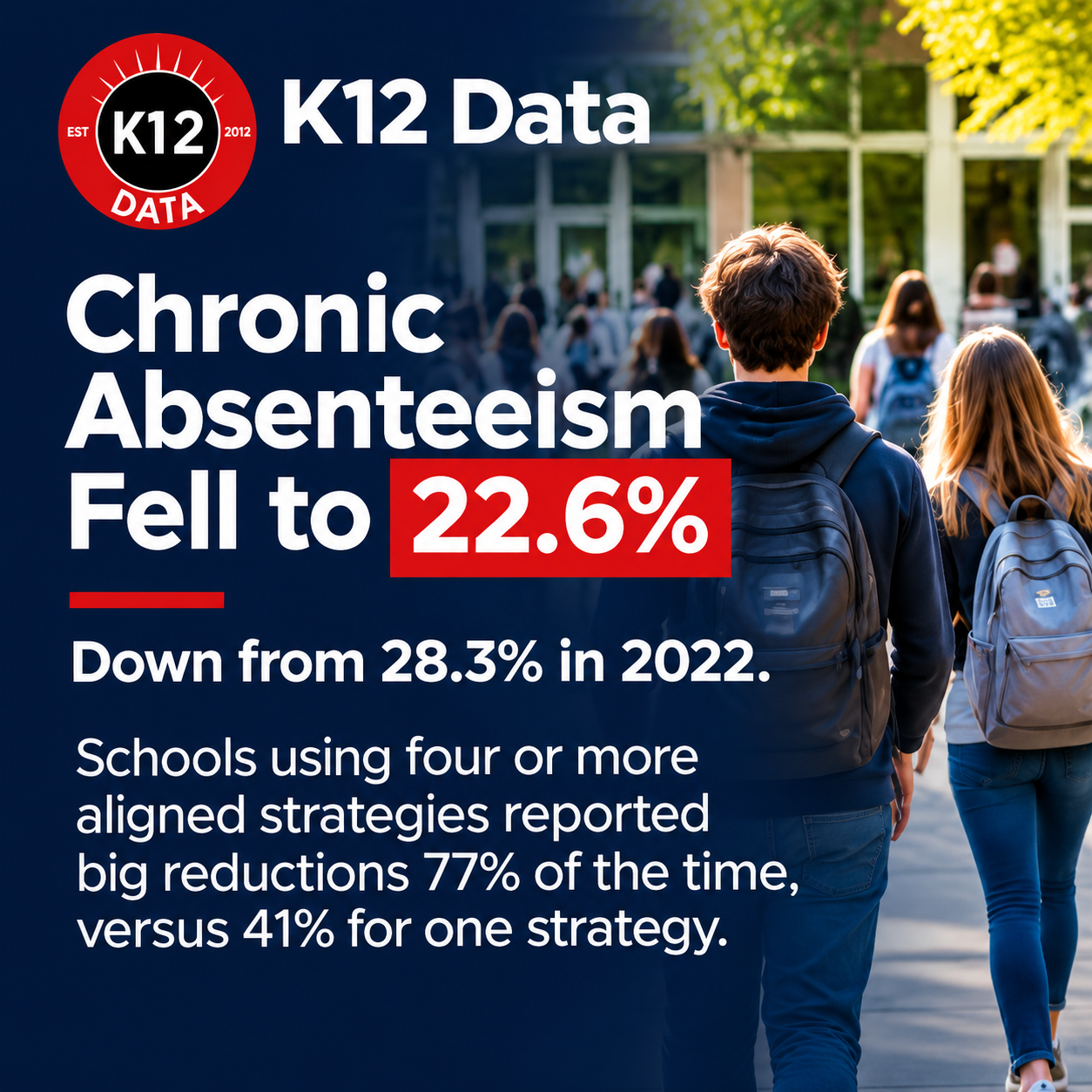
- Chronic absenteeism was 15.4 percent in 2019, rose to 28.3 percent in 2022, and fell to 22.6 percent in 2025, per a 45-state American Enterprise Institute analysis cited by K-12 Dive on October 26, though most schools still have more absences than before the pandemic.
- A principal-survey analysis from Johns Hopkins University's Everyone Graduates Center and partners found schools using four or more effective strategies aligned to the causes of absence reported substantial reductions 77 percent of the time, against 41 percent for schools using one.
- School connectedness topped principals' list of effective strategies, and the 2026 Attendance Playbook from FutureEd and Attendance Works organizes more than 30 evidence-based strategies into tiers from universal prevention to intensive support.
- The 77 versus 41 percent comparison is self-reported by principals and shows association, not proven causation, and the article does not report sample sizes.
The Good News First
Attendance is one of the few education numbers moving in the right direction, and districts rarely hear that. Chronic absenteeism, defined as missing about 10 percent of the school year, or roughly 18 days, for any reason, excused or unexcused, was 15.4 percent in 2019. It rose to 28.3 percent in 2022 and fell to 22.6 percent in 2025, according to a 45-state analysis from the American Enterprise Institute, cited in K-12 Dive's October 26 coverage by Kara Arundel. That is a drop of nearly six points in three years.
The report authors are careful to add that most schools still have more absences than before the pandemic. The AEI figures also cover 45 states, not all of them. But the direction is clear, and two new reports released the same day explain what the schools making the fastest progress are doing differently.
The schools improving fastest are not running one great program. They are running several good ones that fit the reasons students miss school.
Report One: What Principals Say Works
The first report analyzes two surveys of principals conducted during the 2024-25 school year. It comes from the Everyone Graduates Center at Johns Hopkins University, the Partnership for Student Success, and the GRAD Partnership. Its central finding is about combinations. Schools that used four or more effective strategies aligned to the causes of absence reported substantial reductions 77 percent of the time. Schools that used a single strategy did so 41 percent of the time.
Capacity mattered too. The effective schools had the people and systems to carry strategies out at scale, not just on paper. Robert Balfanz, director of the Everyone Graduates Center, said, “The nation's school principals show that reducing chronic absenteeism is a challenging task but it can be done.”
Connectedness Comes First
When principals ranked what works, school connectedness topped the list. That includes relationships between students and teachers, relationships among students, and a supportive school environment. It is a reminder that attendance is partly a relationship outcome. A student who knows a particular adult will notice their absence is more likely to show up.
This is good news for budgets, because connection is not an expensive program. A morning greeting at the door, a mentor for every student who has missed several days, a club or team that gives a reason to come, and a quick phone call from someone who knows the family all build connection at modest cost.
Report Two: The 2026 Attendance Playbook
The second report is the 2026 Attendance Playbook from FutureEd and Attendance Works. It lists more than 30 evidence-based strategies organized in tiers. Tier 1 is universal prevention for all students: family and student engagement, relevant instruction, clear communication, and safe, reliable transportation, plus summer and after-school programs. Tier 3 is intensive, individualized support, such as customized help with housing and health needs.
The Playbook's housing suggestions are concrete. They include partnering with local education foundations and using Title I, Part A homeless set-aside funds. It also names the barriers that grew after the pandemic: parents keeping children home for possible illness and a belief that schoolwork can be done digitally at home. Chronic illness, transportation problems, and family demands remain long-standing causes. Hedy Chang, CEO of Attendance Works, said educators and their partners can accelerate progress by building on what works and not reinventing the wheel.
A district that cannot say why its students miss school is guessing which program to buy.
What Seems to Work Less Well
According to the article's summary, effective approaches include family engagement, student connectedness, dedicated attendance teams, and comprehensive, multi-part responses. Less effective approaches include aggressively enforcing truancy laws and running surveys to learn why students are chronically absent. Both reports stress that schools need to understand why students are absent.
A careful reader will notice the tension in that last point. Surveys alone, without action, seem to be what falls short. Understanding the cause of absence is essential, and the article does not provide the evidence behind its claims about enforcement and surveys. A reasonable reading is that districts should diagnose causes using attendance data and conversations with families, then act on what they learn, instead of relying on penalties.
A Fair Look at the Evidence
Several cautions apply. The 77 and 41 percent comparison reflects principals' self-reported outcomes, so it shows association, not proven causation. The article does not report response rates, sample sizes, or how effective was defined. Schools with strong leadership may be both better at attendance and better at carrying out several strategies at once. Treat the findings as a strong guide to promising practice, and measure your own results.
A Starter Plan for the Next 60 Days
Districts can use the reports in a simple sequence. In the first two weeks, pull chronic absenteeism data by school, grade, and student group, and identify where it is highest. In weeks three and four, talk with families and students at those schools to learn what keeps them home, using short conversations, not only surveys. In weeks five and six, choose at least four strategies that match the causes you found, such as a family outreach team, a transportation fix, a mentor program, and a health partnership. In weeks seven and eight, assign owners, set monthly targets, and report progress to the board.
Who Needs to Be Involved
Attendance crosses departments. The superintendent and assistant superintendents set priorities and resources. Elementary and high school principals run the daily work. The director of student services and the attendance coordinator lead teams and data. The director of family engagement builds relationships with parents and guardians. School board members approve policy and funding and can help communicate with the community.
For a deeper look at who sits where, see our guide to the 25 K-12 decision-maker job titles every education marketer should know.
Use Data, and Use It Early
Early warning data helps. Districts that review attendance weekly, flag students who have missed two or three days, and reach out quickly often prevent the pattern from becoming chronic. Dashboards do not need to be complicated. A shared list by school, updated each Monday, and a clear owner for each name can be enough. Our look at how educators use AI to save time covers one way districts are freeing staff capacity for work like this.
Questions Boards Will Ask
Board members who read about the reports will ask sensible questions. What is our chronic absenteeism rate, and how has it changed since 2022? Which schools and student groups have the highest rates? What strategies are we using, and how many? What are we spending, and what are we getting? How are we communicating with families? A superintendent who can answer with current numbers shows the board that attendance is being managed as a priority.
Why Combinations Beat Single Programs
The 77 versus 41 percent gap is easy to misread as a ranking of programs. It is better read as a warning about single fixes. Students miss school for different reasons: an illness that keeps recurring, a bus that does not come, a bullying problem, a parent working nights, a teenager who has stopped seeing the point. A program built for one of those causes will miss the others. A bundle covers more of the map.
That is also why the reports stress alignment. Four strategies that all address transportation will not help a school whose main problem is disengagement. Districts should write the cause next to each strategy on one page. If two strategies share a cause and three causes have none, the plan needs rebalancing.
Small Moves That Cost Little
Not every strategy needs new funding. A principal can start calling families on the second consecutive absence. Teachers can mark a student's return with a welcome, not a question about where they were. Schools can recognize improvement, not only perfect attendance, since a student who goes from 30 missed days to 15 has done something real. Counselors can run a short check-in group for students who have started to drift.
Messaging matters as well. Families often do not realize that missing two days a month adds up to chronic absence. A simple monthly note showing days missed and what that means can change behavior, particularly when it comes from a person the family knows and not a generic automated notice.
Where Student Voice Fits
The reports caution against relying on surveys to learn why students miss school, but that does not mean ignoring students. The distinction is between asking and acting. A short conversation with a student or parent, followed by a concrete change, builds trust. A long questionnaire that never produces anything can erode it. Districts should ask fewer questions and close the loop on every answer.
Tracking Progress Without Overreach
Targets help when they are specific. A district might aim to reduce chronic absenteeism by two points this year, with school-level goals set by principals. Monthly reviews matter more than annual ones, because a pattern caught in November can still be changed before spring. Report results to the board in plain terms: the rate, the change, the strategies in use, and what the district will do next.
Signals to Watch
Several developments are worth following: whether the national rate keeps falling toward pre-pandemic levels, whether more states and districts adopt multi-strategy attendance plans, how districts report results for connectedness programs, and whether future research tests the claims about enforcement and surveys more directly. Each will show whether the recent progress is durable.
What Vendors Should Take From This
Companies that serve schools can help with the parts that need capacity. Attendance data platforms, family communication tools, transportation providers, mentoring programs, tutoring and engagement services, and school health partners all connect to the strategies the reports describe. The strongest offers fit into a multi-strategy plan, are honest about what they do, and help districts measure results. Reaching the right decision makers while districts are planning matters.
If you want to reach the people who lead these efforts, K12 Data can help. Our school district email lists and K-12 database give you education contact data for every role in this story: a superintendent email list, an assistant superintendent email list, an elementary school principal email list, a high school principal email list, a director of student services email list, an attendance coordinator email list, a director of family engagement email list, and a school board member email list. If you are ready to buy school email list data, or want a K-12 marketing database filtered by role, state, and district size, build a targeted list here while districts are setting attendance goals for the second semester.
Frequently Asked Questions
What is chronic absenteeism?
Chronic absenteeism means missing about 10 percent of the school year, roughly 18 days, for any reason, excused or unexcused. It was 15.4 percent in 2019, 28.3 percent in 2022, and 22.6 percent in 2025, according to a 45-state AEI analysis.
How can schools reduce chronic absenteeism?
Two reports released October 26 point to combining strategies. Schools using four or more effective strategies aligned to the causes of absence reported substantial reductions 77 percent of the time, against 41 percent with one. School connectedness topped principals' list.
Who is responsible for student attendance in a school district?
Principals run daily attendance work, with the director of student services, attendance coordinators, and family engagement leaders supporting them, and the superintendent and school board setting priorities, policy, and funding.