
 0

There are 0 items in your cart: Cart Subtotal: $ 0.00
Students at a New York High School Ran Their Own Budget Vote, and Districts Can Turn Budget Season Into a Civics Lesson

 Everything Else
 0
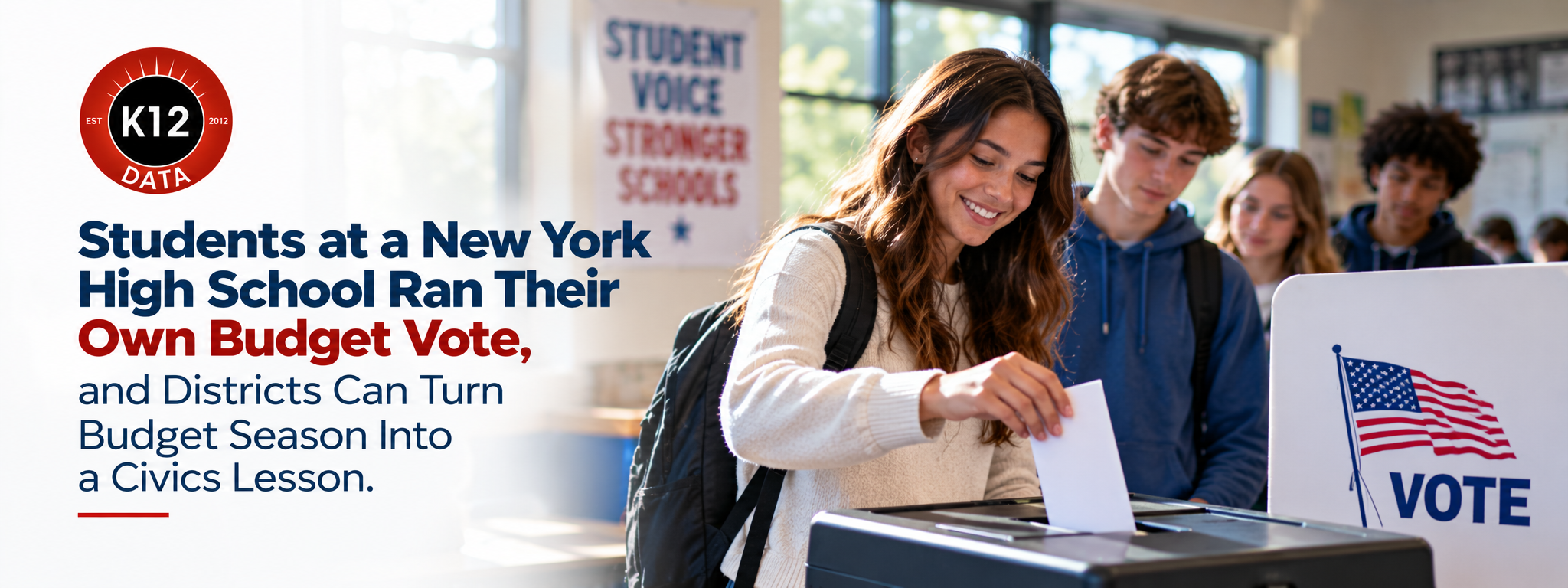
A New York high school let students choose how to spend $25,000 through a real election. Here is how it worked, what it produced, and a starter plan any district can follow.
Students at a New York High School Ran Their Own Budget Vote, and Districts Can Turn Budget Season Into a Civics Lesson
At a national school business conference, Saratoga Springs showed how 1,900 high schoolers picked a winning project for $25,000 using real ballots and voting machines. The model is simple enough for any district to try.
Key Takeaways
• At the ASBO 2026 conference, Saratoga Springs City School District's Joseph Greco described a program in which students at Saratoga Springs High School, about 1,900 students, chose how to spend $25,000, according to K-12 Dive on October 19.
• The process ran from September 2025 to June 2026: a student survey, a committee, a feasibility review, an official ballot, campaigns, and a March vote on real voting machines using ranked choices.
• Students picked a cafeteria grill from five options, the district used leftover funds for bathroom privacy upgrades, and facilities changed its budget to install bocce courts.
• Greco's advice for other districts: secure real money first, assign two paid teacher advisors, build an authentic ballot, and fund the project well enough to avoid disappointment.
What Saratoga Springs Did
Budget season is rarely anyone's favorite part of the school year. A New York high school has found a way to turn it into something students look forward to. At the Association of School Business Officials International's 2026 Annual Conference & Expo in Pittsburgh, Joseph Greco, director of personnel development for the Saratoga Springs City School District, described a participatory budgeting program at Saratoga Springs High School. K-12 Dive's Anna Merod reported on it October 19.
The idea is simple. Students at a school of about 1,900 were given $25,000 and a real decision: how should it be spent? They gathered ideas, narrowed them, checked feasibility with district leaders, campaigned for their favorites, and then voted in an official election. The district then carried out the winning project.
Participatory budgeting works when the money is real, the ballot is real, and the result is honored.
Why the District Started
Greco said several problems prompted the effort. Students and local adults struggled to understand how capital project funding worked, especially during a lean budget season. Students were vandalizing school facilities, which he linked to a lack of pride and ownership. Age-eligible students rarely voted and were nervous about casting a ballot because they did not know the process. And curriculum leaders and teachers wanted students to build communication skills and global citizenship, which connects to New York's portrait of a graduate.
Greco described the program as a way to connect school finance to authentic civic learning, with transparency, trust, and ownership as the goals. It is an unusual idea because it links two parts of a district that rarely work together: the business office and the social studies classroom.
The Calendar: Nine Months, Seven Steps
The timeline offers a model other districts can copy. In September 2025, students were recruited to lead a committee, and a survey of the whole student body gathered ideas. In November, the committee consolidated and narrowed the list. In December, it met with district leaders to check feasibility. In January, an official ballot was created. In February, students campaigned for the top five projects.
In March, all students in grades 9 through 12 voted on official voting machines using ranked voting, during their social studies class blocks. Volunteer poll workers ran the vote in the school auditorium. From April through June, the winning project was implemented. Every step was designed to look and feel like a real election.
Five Options and a Winner
Students chose among five finalists: bocce courts, a cafeteria grill, upgraded feminine hygiene products in bathrooms, bathroom privacy upgrades through facility work, and outdoor water bottle dispensers. The cafeteria grill won. Students held a ribbon-cutting with free grilled chicken samples and invited administrators, local politicians, and chamber of commerce members.
The results spread beyond the winner. Bathroom privacy upgrades came in second, and the district used leftover funds after buying the grill to pay for them. The bocce courts did not receive extra money, but the facilities team changed its budget to install them after talking with students. As Greco put it, “It's a grill, but they still wanted to have a ribbon cutting because they were super excited, because it was their idea.”
A ribbon-cutting for a cafeteria grill tells you what ownership looks like. It was their idea.
What the Results Show, and What They Do Not
Greco said students became more engaged in voting and came to see that their voice “had meaning.” That is a meaningful outcome, and it matches what civics educators hope for. It is also worth being clear about the limits. This is one school in one year, described by the person who ran it. The article does not report voter turnout figures, changes in vandalism, or survey results, so the benefits should be treated as promising and local, not proven.
The practical value of the story is the design, not the statistics. A district that wants to test the idea can borrow the structure, collect its own data, and decide after one cycle whether it is worth continuing.
Greco's Advice for Other Districts
Greco offered several lessons. First, secure funds before involving students. Saratoga Springs took the money from its general fund, and he cautioned that grants and private donations can be less stable. Second, frame the budget line for the board as boosting student voice and choice, and as a strong return on investment for civic readiness.
Third, plan for staffing. Assign two teacher advisors to keep students on schedule, and pay a stipend for club advisors. Fourth, make the experience authentic. Create a real ballot, and budget for printing, voting machines, and poll workers from local government. Greco also warned that if funding is too small, the process “may lead to disappointment in the process and low participation.”
A Starter Plan for a Pilot
A district interested in trying this does not need a full-scale program on day one. A reasonable first step is a pilot at one high school or one middle school with a modest, real amount of money. Choose an amount that can buy something visible and fund it from the general budget. Recruit a student committee with a mix of grades and interests, and name two faculty advisors with a stipend.
Build the calendar backward from a vote in the spring, leaving time for feasibility review and for the project to be completed before the school year ends. Decide in advance which kinds of projects are eligible, such as facilities, equipment, and student-life improvements, and which are not. Publish the rules so students know the boundaries before they start.
Why It Fits the Civics Mission
Many states and districts are looking for ways to give students practical civic experience before they reach voting age. A participatory budget touches nearly every skill on the list: researching a question, persuading peers, weighing tradeoffs, respecting a process, and accepting a result. It also teaches something less common, which is how public money actually moves from an idea to a purchase.
That is a worthwhile lesson for adults as well. Families and taxpayers who see students working through a budget decision often come away with a better understanding of how the district handles its own. Transparency in a small project can build trust for a larger one.
Who Makes This Happen in a District
A project like this crosses several desks. School business officials and chief business officers manage the funds and the rules. High school principals provide support and space, and directors of student activities and social studies department chairs often lead the student side. Assistant superintendents and the superintendent decide whether the program fits district priorities, and the school board approves the budget line.
Our guide to the 25 K-12 decision-maker job titles shows how those roles typically divide the work. For anyone who serves this audience, the lesson is that a good outreach plan reaches both the leader who funds a program and the person who runs it.
Talking With Families and the Board
Communication helps a program like this succeed. A short explanation for families should say what the budget is, how students decide, and what happens to the result. A brief update to the board before the vote avoids surprises, and a ribbon-cutting at the end gives the district a chance to share the story.
The same principle applies to other new programs. As we noted in our look at the Walton Family Foundation and Gallup survey on teachers and AI, clear guidance and plain communication help districts turn scattered activity into shared practice, and they build trust along the way.
What Vendors and Partners Can Do
Companies that serve schools have a role. Providers of voting technology can offer simple, secure options for student elections. Civics and social studies publishers can build lesson sequences around a budget project. Finance and transparency tools can help districts present budget information in forms students can read. Local governments can lend voting machines and poll workers, as Saratoga Springs did.
The common thread is that districts want ideas they can implement with their existing staff and budget. Partners who offer simple templates, calendars, and ballots, and who are willing to work around school schedules, will find a receptive audience among business officials and principals.
When the Winner Is Not What Adults Expected
One of the most useful parts of the Saratoga Springs story is that the winner was a cafeteria grill. Adults might have chosen water bottle dispensers or something that sounded more serious. The point of the exercise is that students own the decision, and leaders have to be ready to honor it. When the district used leftover funds to build the second-place bathroom privacy upgrades, and when facilities changed its budget to install the bocce courts, students saw that their votes had consequences beyond the top finisher.
That kind of follow-through is what separates participatory budgeting from a suggestion box. Districts that want the program to build trust need to decide before the vote how they will treat second- and third-place ideas, and be open about what they can and cannot do.
Keeping the Workload Reasonable
Greco's staffing advice is worth repeating because programs fail when they depend on volunteers who burn out. Two teacher advisors share the load and keep the committee on schedule, and a stipend recognizes the extra hours. The business office contributes the money and the rules, and a few hours from facilities staff for feasibility checks keeps ideas realistic. With that structure, the program becomes a recurring part of the school year, not a heroic one-time project.
Signals to Watch
Several developments are worth following: whether other districts announce participatory budgeting pilots this year, whether states encourage student budget projects as part of civics requirements, how districts report participation and satisfaction, and how business officials share their experience at future ASBO meetings. Each will show whether the idea moves from a single high school to a wider practice.
If you want to reach the people who run these decisions, K12 Data can help. Our school district email lists and K-12 database give you education contact data for every role in this story: a school business official email list, a chief business officer email list, a high school principal email list, a director of student activities email list, a social studies department chair email list, a superintendent email list, an assistant superintendent email list, and a school board member email list. If you are ready to buy school email list data, or want a K-12 marketing database filtered by role, state, and district size, build a targeted list here while districts are planning next year's budgets.
Frequently Asked Questions
What is participatory budgeting in schools?
Participatory budgeting lets students help decide how a set amount of school money is spent. At Saratoga Springs High School in New York, students surveyed peers, formed a committee, campaigned for finalists, and voted on real voting machines to choose how to spend $25,000.
How can students help decide school spending?
A common model is a student committee that gathers ideas, checks feasibility with district leaders, creates an official ballot, and holds a vote. Joseph Greco of Saratoga Springs advises securing funds first, assigning paid teacher advisors, and keeping the process authentic.
Who manages the budget in a school district?
School business officials and chief business officers manage funds and rules, with support from the superintendent and assistant superintendents. The school board approves the budget, and principals oversee spending in each building.